



You are selling a cybersecurity product to a Fortune 500 company. You have cleared the technical evaluation. The customer's CISO is bought in. Then the procurement process starts — new vendor security questionnaire, legal review of data processing terms, IT onboarding, finance approval for budget that was not pre-planned. Six weeks later you still do not have a signed contract, and two of your competitors are starting the same process with the same buyer.
This is the reality of enterprise cybersecurity sales through direct channels. It is slow, it is friction-heavy, and it disproportionately benefits incumbent vendors who are already in the customer's procurement system.
Cloud marketplace changes this picture dramatically for cybersecurity ISVs — and understanding how requires looking at the specific dynamics that make security products uniquely well-suited to marketplace distribution.
Why Cybersecurity Products Sell Well on Cloud Marketplace
Cybersecurity is consistently one of the highest-performing product categories on AWS Marketplace, Azure Marketplace, and GCP Marketplace. This is not a coincidence — it reflects a structural alignment between how enterprise security is procured and what cloud marketplaces are designed to do.
Security Budgets Follow Cloud Spend
As enterprises have moved their infrastructure to the cloud, their security budgets have followed. The security tools that protect cloud infrastructure — cloud security posture management (CSPM), cloud-native application protection platforms (CNAPP), endpoint detection and response (EDR) for cloud workloads, identity and access management — are increasingly evaluated in the context of the cloud environment they protect.
It is natural for these tools to be procured through the same channel as the cloud infrastructure itself.
Enterprise security teams have also become sophisticated cloud buyers. CISOs at large enterprises often have direct relationships with their AWS or Azure partner managers, which means they are already connected to the ecosystem that makes marketplace procurement straightforward.
Committed Spend + Security = Fast Procurement
The combination of committed cloud spend and security procurement urgency creates particularly powerful marketplace dynamics. When a security incident or a new vulnerability drives urgency to deploy a new tool quickly, procurement speed is critical.
The marketplace shortcut — where a pre-approved vendor can be deployed against committed spend without a new procurement cycle — is not a minor convenience. It can be the difference between deploying a security tool in days versus weeks.
Security buyers with large committed cloud balances are actively looking for ways to apply those balances to security tooling. The CISO who has been told to improve cloud security posture now has a mechanism to do it quickly, within budget that has already been approved at the board level, through a procurement channel that does not require standing up a new vendor relationship from scratch.
Trust Inheritance from Cloud Providers
Being listed on AWS Marketplace, Azure Marketplace, or GCP Marketplace carries implicit trust signals that matter in security buying decisions. The cloud providers vet ISVs for their marketplace participation (though the vetting is not a full security audit), and buyers know that a marketplace-listed vendor has met a baseline set of requirements — active product, functional SaaS integration, legitimate business entity.
For security buyers evaluating unknown vendors, marketplace listing provides a layer of trust that a cold outreach email does not.
This trust signal is amplified significantly by competency programs, which we will cover in detail shortly.
Compliance: The Foundation of Your Security Marketplace Strategy
Before you build your marketplace listing strategy, you need to be clear about your compliance posture. In enterprise security, compliance certifications are not just nice-to-have marketing assets — they are often required gates in the procurement process.
If you want a faster path through the analysis, the Marketplace Readiness Assessment is free and takes under five minutes to assess your readiness before investing in listing work.
Understanding which certifications matter for your target buyers, and which cloud marketplaces are best positioned for those buyers, is foundational planning work.
SOC 2 Type II: The Baseline
For any enterprise security product, SOC 2 Type II is the minimum. Enterprise security buyers will ask for it early in the evaluation process, and its absence is a deal-stopper for many procurement teams.
If you do not have SOC 2 Type II, prioritize it before investing heavily in marketplace listing — the listing will generate leads that the SOC 2 absence will kill.
Both AWS and Azure require evidence of appropriate security controls for ISVs participating in their partner programs. Having SOC 2 Type II documentation available is part of the standard due diligence package for co-sell engagements.
FedRAMP: The Government Market Gate
FedRAMP (Federal Risk and Authorization Management Program) authorization is the compliance requirement for selling cybersecurity products to US federal government agencies. The program has two primary authorization levels: FedRAMP Moderate (most civilian agency use cases) and FedRAMP High (national security and sensitive data environments).
Pursuing FedRAMP authorization is a significant investment — the process typically takes 12 to 24 months and costs $500,000 to $2 million or more when you include preparation, third-party assessment, and ongoing monitoring costs. But for security companies with a viable government market opportunity, FedRAMP is not optional.
Government buyers cannot legally procure non-FedRAMP-authorized tools for systems that handle controlled data.
The marketplace implications of FedRAMP are significant: FedRAMP-authorized products can be listed and sold through AWS GovCloud Marketplace and Azure Government Marketplace — specialized marketplace instances designed specifically for government procurement. These government marketplace instances are separate from the commercial marketplaces and require separate listings, but they access a buyer pool with very high deal values and low competitive density for compliant vendors.
CMMC: Defense Contractor Requirements
CMMC (Cybersecurity Maturity Model Certification) is the compliance framework required for Department of Defense contractors and their supply chains. CMMC Level 2 (the most common requirement for prime contractors handling Controlled Unclassified Information) requires compliance with NIST SP 800-171 controls.
If your security product is used by or sold to defense contractors, CMMC compliance is an increasingly important selling point. Defense contractors evaluating security tools will ask about CMMC alignment as part of their own compliance diligence.
Having a clear CMMC alignment story strengthens your position in this segment.
HIPAA and SOC 2 Healthcare
For cybersecurity products used in healthcare environments — particularly HIPAA-covered entities — Business Associate Agreement (BAA) availability and HIPAA-aligned controls are required. AWS and Azure both offer marketplace contexts that support HIPAA workloads, and listing in the healthcare vertical sections of their marketplaces is more accessible if you have your BAA and HIPAA documentation in order.
GovCloud: The High-Value Government Marketplace
AWS GovCloud and Azure Government are specialized cloud regions designed specifically for US government workloads. They are physically isolated from commercial cloud regions, operated by US persons, and built to meet the compliance requirements of government data environments (ITAR, FedRAMP, DoD IL2/IL4/IL5).
Both GovCloud regions have associated marketplaces: AWS GovCloud Marketplace and Azure Government Marketplace. These are separate marketplace instances from the commercial marketplaces, and they require separate listing applications.
Approval processes are more rigorous — AWS and Azure need to verify that you and your product meet the requirements for government-only marketplace participation.
Why GovCloud Marketplace Is Worth It
Government deals are large, committed spend is substantial (government cloud commitments are often multi-hundred-million-dollar agreements), and competitive density in the GovCloud marketplace is far lower than in the commercial marketplace. For security companies with FedRAMP authorization or ITAR compliance, being in the GovCloud marketplace puts you in front of a buyer pool that your non-compliant competitors literally cannot reach.
The co-sell dynamics in GovCloud are also distinct. AWS and Microsoft have dedicated public sector field teams with deep relationships in federal agencies, defense contractors, and state and local governments.
An active co-sell relationship with the AWS Public Sector team or Microsoft's Federal team can surface your product in procurement conversations that you would never reach through direct outreach.
The Security Buyer Persona
Understanding who you are selling to on cloud marketplace shapes every aspect of your listing strategy — the language you use, the benefits you emphasize, and the compliance credentials you surface.
Enterprise security purchases on cloud marketplace typically involve three buyer personas:
The CISO (Economic Buyer)
The CISO controls the security budget and makes the final purchase decision. CISOs care about risk reduction, compliance alignment, board-level narratives ("we are SOC 2 compliant, we have zero-trust architecture"), and total cost of ownership.
In marketplace terms, the CISO is often the person who directs the team to "check if this is on marketplace" because they have committed cloud spend they want to deploy efficiently.
Your listing headline and product description need to speak the CISO's language: risk reduction, compliance, detection and response capability, time-to-value. Avoid technical implementation details at the listing level — save those for the technical evaluation materials.
The Security Engineer (Technical Evaluator)
Security engineers do the hands-on technical evaluation. They care about integrations (does it plug into our SIEM, our SOAR, our identity provider?), detection quality (false positive rate, coverage against MITRE ATT&CK framework), deployment model (agent-based vs. agentless, cloud-native vs. on-prem), and operational overhead (how many analysts do we need to run this?)
Your listing technical documentation, trial experience (if available), and integration library need to address these concerns. Security engineers often initiate marketplace discovery before the CISO is involved — a clear technical documentation page and a well-configured product listing can bring security engineers to you.
The Cloud Architect (Integration Champion)
Cloud architects evaluate how your security product integrates with the cloud environment. They want to know: does it run natively on AWS/Azure/GCP? Does it use cloud-native services (CloudTrail, AWS Security Hub, Microsoft Sentinel, Google Cloud Security Command Center)?
Does it add infrastructure overhead? Does it conflict with existing IAM policies?
Products that demonstrate deep cloud-native integration — and especially products that enhance the cloud provider's own security services — get favorable treatment in co-sell conversations because the cloud seller can position them as an extension of the customer's existing cloud investment.
AWS Security Competency: The Most Valuable Badge on AWS Marketplace
The AWS Security Competency is a partner designation awarded to ISVs whose security products have been technically validated and demonstrated in customer environments. It is, in practice, the highest-credibility signal a security ISV can display on AWS Marketplace.
Achieving AWS Security Competency requires:
- Active AWS Partner Network membership at the Select tier or above
- A technical review of your product by AWS partner engineers
- Customer references demonstrating successful AWS deployments
- Documented alignment with AWS security best practices
- At least one AWS-delivered customer success story
The business benefits of AWS Security Competency are significant. Competency partners receive prominent badging on their marketplace listing, priority placement in the AWS Security category, AWS co-invest funding for co-sell activities, and access to the dedicated AWS Partner Network security team that works deals with you rather than just referring them.
For security companies serious about marketplace as a GTM channel, pursuing AWS Security Competency should be on the roadmap within the first 12 months of marketplace launch. It is not fast (the validation process takes 3 to 6 months) and it is not free (it requires partner team investment), but the co-sell advantages it unlocks are worth the investment for any company targeting enterprise AWS customers.
Azure and GCP Equivalent Programs
Microsoft offers the Azure Security specialization, which functions similarly to the AWS Security Competency — a validated designation for ISVs with proven security capabilities on Azure. For companies targeting Microsoft-centric enterprise security buyers, this specialization accelerates co-sell engagement with Microsoft field teams.
GCP offers the Google Cloud Security partner specialization for ISVs demonstrating security expertise on Google Cloud. The GCP security marketplace is less mature than AWS or Azure security marketplaces, which means the competitive opportunity for early-mover security ISVs is higher.
Building Your Security Marketplace Listing: Key Elements
Leading with Risk Reduction, Not Features
Enterprise security buyers evaluate products through the lens of risk reduction: what specific risks does this product reduce, by how much, and what evidence supports that claim? Your listing description should lead with risk reduction language — "reduces mean time to detect cloud threats by X%," "eliminates credential-based lateral movement in AWS environments" — rather than feature lists.
Surfacing Compliance Credentials Prominently
Your compliance certifications (SOC 2, FedRAMP, HIPAA, CMMC alignment) should be prominently displayed in your listing. Enterprise security buyers filter on compliance credentials before they read product descriptions.
If your compliance credentials are buried in supporting documentation rather than visible in the listing overview, you are losing deals at the filtering stage.
Integration Ecosystem Documentation
A security product without documented integrations is a security product that adds operational overhead. Document your integrations — SIEM platforms (Splunk, Sentinel, Chronicle), SOAR tools (XSOAR, Splunk SOAR), identity providers (Okta, Azure AD), and cloud-native security services — prominently in your listing.
The more integrations you document, the more search terms your listing is discoverable for.
Where Automatum Fits In
Security companies typically face the marketplace listing process with two significant constraints: limited partnerships or business development headcount to manage the listing and co-sell workflows, and engineering teams that cannot spare cycles for marketplace integration work (which can require building metered billing APIs, SaaS subscription integrations, and custom webhook configurations).
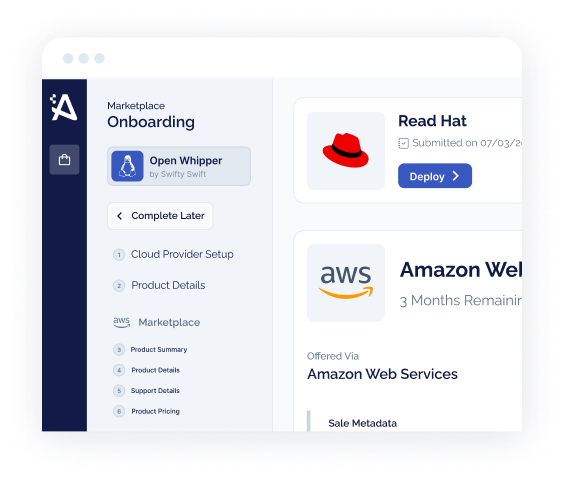
Automatum removes the engineering barrier entirely. Security ISVs use Automatum to create and manage listings on AWS, Azure, and GCP Marketplace — including private offers, metered billing, and co-sell workflows — without writing marketplace-specific code.
For a security team that should be focused on detection engineering and threat research rather than cloud marketplace plumbing, that is not a minor convenience. It is the difference between going live in weeks and going live in quarters.
The Security Category Is Underserved on Marketplace
Despite being one of the highest-performing categories on cloud marketplaces, the security section of every major marketplace is still underserved relative to the size of the addressable market. There are thousands of enterprise security products.
A fraction of them are on marketplace with optimized listings, active co-sell relationships, and competency designations.
For security ISVs with enterprise ambitions, this is an opportunity window. The buyers are on marketplace, the committed spend is ready to be deployed, and the co-sell infrastructure is in place.
The companies that establish a strong marketplace presence in the security category now — with compliance credentials surfaced, competency programs pursued, and co-sell relationships activated — will be the ones that close deals faster and at higher volumes as the category continues to mature.
Automatum simplifies cloud marketplace operations across AWS, Azure, and GCP.
Book a Working Session →Frequently Asked Questions
Common questions about the topics covered in this guide.
What compliance certifications do cybersecurity ISVs need for marketplace?
At minimum SOC 2 Type II. For government customers, FedRAMP Moderate or High is required. CMMC certification is increasingly expected for defense-related buyers. HIPAA compliance is needed for healthcare security products.
Should cybersecurity companies list on GovCloud marketplace?
Yes, if you serve government customers. AWS GovCloud and Azure Government marketplaces provide access to federal buyers with committed spend. FedRAMP authorization is required for GovCloud listings.
What are the key buyer personas for cybersecurity marketplace products?
Three personas drive security marketplace purchases: CISOs evaluate strategic fit and compliance, security engineers evaluate technical capabilities and integration, and cloud architects evaluate deployment architecture and resource requirements.
How does the AWS Security Competency help marketplace listings?
AWS Security Competency provides a trust badge on your marketplace listing, priority placement in security-related searches, access to specialized co-sell opportunities, and recognition from AWS security-focused field sellers.
Keep building your marketplace motion
Vertical and listing guides for cybersecurity ISVs.