


You joined eight months ago. The board expects marketplace revenue to be 20% of pipeline by next year. Your team has listings on AWS and Azure, but revenue is trickling. This is the guide you needed on day one.
- 67% of companies identify cloud partner alliances as a top 2026 priority
- 96% of enterprise deals involve partners — avg 7 partners per deal
- This guide covers team structure, co-sell motions, multi-cloud strategy, and the 8 metrics that matter
- Written for VPs of Partnerships stepping into marketplace management for the first time
The VP of Partnerships' Marketplace Reality
Here's what this actually means for your listing: you have a board slide with a circled number, a sales team that treats marketplace as someone else's job, and PDM calls that go unanswered because there's nothing substantive to discuss.
Sound familiar? You're not alone.
You inherited listings that someone in product marketing launched eighteen months ago. They checked the box — "we're on AWS Marketplace" — and moved on. Revenue is a rounding error. Your AEs don't understand co-sell. Your channel team is still running the old reseller playbook. And the board just read a Forrester report saying 67% of software companies identify partner alliances as their top 2026 growth priority, so now everyone wants to know why your marketplace number isn't bigger.
The painful truth: you don't have a listing problem. You have an operating problem.
The question isn't whether to be on marketplace. It's whether you're treating it like a channel or a checkbox.
In practice, this process takes months to fix because the gap between "listed" and "generating revenue" is enormous. Research from Clazar and Partner Insight confirms what we see every day: 89% of ISVs are listed on at least one cloud marketplace, but only 22% generate more than 20% of their revenue through it. We call this the Listing-to-Revenue Gap, and closing it is the core job of a VP of Partnerships in 2026.
The complexity is real. McKinsey reports that 96% of enterprise software deals now involve partners, with an average of 7 partners per deal. You sit at the center of that complexity. This guide is the briefing we give every VP of Partnerships who comes to us asking where to start.
The gap between "listed" and "generating revenue" is the core challenge. Treat marketplace as an operating discipline — not a distribution checkbox. Companies that assign dedicated headcount and systematic co-sell processes consistently outperform those that bolt marketplace onto existing partner roles.
The Marketplace Management Problem
The deadline most ISVs miss is the one nobody writes down: the point at which a listing stops being "new" and becomes "stale" in the eyes of your cloud partner's field team. In practice, this process takes about 90 days. If you haven't generated co-sell activity by then, your PDM moves on to the next ISV who will.
Forrester's 2026 channel survey found that 67% of software companies now rank partner alliances as their top strategic priority. That's not aspirational — it reflects the economics. WorkSpan data shows partner-influenced deals close at 2-3x higher win rates, are 2.5-3x larger, and move 30-35% faster through the pipeline. Companies scaling to $250M+ ARR typically need approximately 25% of revenue flowing through channel and partnership motions (Invisory).
89% of ISVs are listed, but only 22% generate meaningful revenue. The difference isn't the listing — it's the operations behind it.
But here's the gap: while 89% of ISVs are listed, only 22% are generating more than 20% of their revenue through marketplace. The Listing-to-Revenue Gap exists because most companies treat marketplace as a distribution checkbox rather than an operating discipline. They launch a listing, assign it to someone with six other responsibilities, and wonder why the revenue doesn't materialize.
The VP of Partnerships role exists precisely to close this gap. You're the one who has to build the machine — the co-sell motion, the operational infrastructure, the cross-functional alignment — that turns a static listing into a revenue channel.
- Listing exists but no one owns it
- Sales team bypasses marketplace
- Manual private offers take hours
- No metrics or attribution
- Single-cloud, no co-sell
- Dedicated marketplace manager
- Sellers lead with marketplace offers
- Automated workflows across 3 clouds
- 8 key metrics tracked monthly
- Active co-sell driving pipeline
What Marketplace Management Actually Involves
Here's what this actually means for your listing when you break marketplace management into its operational components. It's not one job. It's five distinct operational pillars, and most organizations are only doing the first one well.
Listing Management
Product pages, pricing models, and metadata across AWS, Azure, and GCP.
Co-Sell Operations
Opportunity registration, partner alignment, and pipeline management with cloud field reps.
Transaction & Billing
Private offers, metering, disbursement tracking, and revenue recognition.
Analytics & Reporting
Pipeline attribution, marketplace revenue metrics, and partner performance tracking.
Pillar 1: Listing Management Across Clouds
Creating and maintaining product listings on AWS Marketplace, Azure Marketplace, and GCP Marketplace. Each cloud has different listing requirements, review processes, and metadata schemas. Keeping pricing, descriptions, and compliance status current across all three is a full-time coordination exercise.
Pillar 2: Private Offer Creation and Tracking
Enterprise deals almost never transact at list price. Private offers — customized pricing with negotiated terms, durations, and payment schedules — are how real revenue flows. Creating, tracking, and reconciling private offers across clouds requires operational precision.
Pillar 3: Co-Sell Pipeline and ACE/Referral Management
This is where revenue acceleration happens. On AWS, you create ACE (AWS Customer Engagements) opportunities. On Azure, you work through the IP Co-Sell program. On GCP, it's the Partner Advantage referral system. Each has different submission requirements, approval workflows, and attribution models. Managing this systematically — not ad hoc — is what separates top performers.
Pillar 4: Metering and Billing Reconciliation
If you sell usage-based or consumption-based products, your metering integration must report accurate usage to the cloud provider's billing system every hour. Metering failures mean you don't get paid. Billing discrepancies create customer escalations. Most VPs underestimate this pillar until the first revenue reconciliation meeting.
Pillar 5: Partner Program Compliance
AWS requires FTR (Foundational Technical Review) completion for ISV Accelerate eligibility. Azure's IP Co-Sell designation has its own technical and business requirements. GCP's Partner Advantage tiers demand specific certifications and customer references. Falling out of compliance means losing co-sell support, paying higher fees, and being deprioritized by field sellers. Most VPs underestimate this pillar as well — until their ISV Accelerate status is at risk.
Building and maintaining marketplace integrations in-house costs $35K–$82K per cloud in engineering time alone, consuming 400–700 hours annually. That's before accounting for the operational overhead of private offer management, billing reconciliation, and compliance maintenance across three clouds.
The Multi-Cloud Reality
Enterprise multi-cloud adoption sits at 89% (Clazar). Your buyers are already on multiple clouds. The question isn't whether to go multi-cloud — it's how fast you can get there.
The revenue case is overwhelming. Tackle's marketplace data shows that multi-cloud ISVs generate 29% of their revenue through marketplace, compared to just 3% for single-cloud ISVs. That's a 10x gap. Your board is right to push for all three clouds.
Multi-cloud ISVs generate 29% of their revenue through marketplace, compared to just 3% for single-cloud ISVs (Tackle). With $470B+ in committed spend across AWS EDP, Azure MACC, and GCP CUDs, the opportunity is spread across all three clouds — and buyers want to draw down that spend through marketplace purchases.
But each cloud operates differently. Here's what this actually means for your listing across providers:
| Cloud | Standard Fee | Reduced Fee (Accelerate/Co-Sell) | Co-Sell Program | Fiscal Year |
|---|---|---|---|---|
| AWS | 3% | 2% (ISV Accelerate) / 1.5% (private offers) | ACE Pipeline Manager | Jan–Dec |
| Azure | 3% | 3% (flat) | IP Co-Sell | Jul–Jun |
| GCP | 3% | 2% / 1.5% (tiered) | Partner Advantage | Jan–Dec |
Different marketplace fee structures, different co-sell programs, different fiscal calendars, different compliance requirements. Managing this across spreadsheets and manual processes breaks down the moment you have more than a handful of active deals. There's more than $470B in committed spend (EDP, MACC, and CUD credits) sitting across the three clouds (Omdia) — and buyers actively want to burn that spend down through marketplace purchases. Your job is to capture your share of it.
For a deeper look at multi-cloud operations, we've written a dedicated guide covering the tactical details.
Building Your Co-Sell Motion
Co-sell is where marketplace revenue actually comes from. The listing is the storefront; co-sell is the sales engine. And the numbers are unambiguous: Canalys reports that co-selling drives 51% higher revenue growth and 65% higher close rates compared to ISVs selling without cloud partner engagement.
Top co-sell performers achieve a 75% win rate on co-sold deals, versus 47% for peers who don't co-sell (Partner Insight). That's the difference between a marketplace program that justifies headcount and one that gets defunded.
But only 58% of ISVs have trained their AEs to route deals through marketplace (Clazar). The deadline most ISVs miss is getting their sales team enabled before the co-sell motion stalls. Here's the framework that works:
Assess existing listings, identify which clouds your buyers are on, and map committed spend opportunities.
Register opportunities in AWS ACE and Microsoft Partner Center. Train AEs on marketplace-led selling.
Replace manual private offer workflows and billing reconciliation with automated tooling.
List on additional clouds where buyer budgets live. Multi-cloud ISVs generate 10x more marketplace revenue.
Track the 8 key metrics, align sales incentives, and iterate on your marketplace GTM motion.
Step 1: Train Your Sales Team
Your AEs need to understand three things: why buyers prefer to purchase through marketplace (committed spend drawdown, single invoice, procurement speed), how to position it in a deal, and what "creating an ACE opportunity" means tactically. This isn't a slide deck — it's enablement that changes deal execution. If you need a playbook for getting sales team buy-in, start there.
Step 2: Establish PDM Cadence
Your Partner Development Manager at each cloud provider is your most important external relationship. Set a biweekly cadence. Come with pipeline data, not asks. Share which of your prospects are on their cloud, which deals are in play, and where you need field seller introductions.
Step 3: Create ACE Opportunities Systematically
Every qualified deal where the buyer runs on AWS should have an ACE opportunity. Every Azure deal should have a referral. This isn't optional extra work — it's how you build attribution, earn co-sell credits, and get your cloud partner's field team invested in your pipeline. Make "Did you create the ACE?" a standard deal review question.
Step 4: Track Co-Sell Influence on Pipeline
Measure what co-sell is actually doing: how many deals have cloud partner involvement, what's the win rate delta, what's the average deal size differential. This data is what you bring to the board to justify more investment. For a comprehensive walkthrough, see our co-sell strategy guide.
One critical obstacle: 42% of ISVs report RevOps resistance to marketplace motions (Clazar). RevOps teams worry about attribution complexity, CRM integration overhead, and commission structure changes. Address this head-on by showing the data — partner-influenced deals are larger, faster, and stickier — and by investing in the tooling that makes marketplace transactions visible in your existing revenue systems.
The Metrics That Matter
You can't manage what you don't measure, and most VPs of Partnerships are tracking the wrong things. Topline marketplace revenue is a lagging indicator. Here are the eight metrics that actually drive marketplace program performance:
| Metric | What It Measures | Benchmark |
|---|---|---|
| Marketplace Revenue as % of Total | Channel maturity | 20%+ for scaling ISVs; 29% for top multi-cloud performers (Tackle) |
| Partner-Sourced Pipeline % | Co-sell effectiveness | 25%+ for companies scaling to $250M ARR (Invisory) |
| Co-Sell Win Rate | Quality of cloud partner engagement | 75% for top performers vs 47% average (Partner Insight) |
| Avg Deal Size: Marketplace vs Direct | Marketplace revenue uplift | 2.5-3x larger for partner-influenced deals (WorkSpan) |
| Time to First Transaction | Listing operational readiness | 60-90 days post-listing |
| Private Offer Conversion Rate | Enterprise deal execution | Track accept rate and time-to-accept |
| Committed Spend Capture Rate | MACC/EDP/CUD drawdown contribution | Growing share of $470B+ pool (Omdia) |
| PDM Engagement Score | Strength of cloud partner relationship | Biweekly cadence with pipeline-backed conversations |
If your board reporting includes only the first metric, you're missing the leading indicators that predict whether marketplace revenue will grow or plateau. Build a dashboard that tracks all eight, updated monthly at minimum.
5 Common Mistakes VPs of Partnerships Make
Mistake 1: Treating Marketplace as a Side Project
The most common failure pattern. Marketplace gets assigned to someone who also manages technology partnerships, integration partners, and maybe SI relationships. It's nobody's primary job, so it doesn't get the operational rigor it demands. Companies that assign dedicated headcount to marketplace operations consistently outperform those that bolt it onto existing partner roles.
Mistake 2: Not Investing in Co-Sell Training
Only 58% of ISVs have trained their AEs on marketplace motions. The other 42% have a co-sell strategy on paper and a sales team that ignores it in practice. Training isn't a one-time event — it's ongoing enablement that includes deal-level coaching, comp plan alignment, and making marketplace the path of least resistance for procurement.
Mistake 3: Ignoring Committed Spend Opportunities
There is more than $470B in committed cloud spend across AWS (EDP), Azure (MACC), and GCP (CUDs) that buyers are contractually obligated to spend (Omdia). Marketplace purchases draw down this committed spend, which means buyers have a financial incentive to purchase through marketplace — often a stronger incentive than any discount you could offer. If you're not positioning your product as a committed spend drawdown vehicle, you're leaving the most powerful buyer motivation on the table.
Mistake 4: Managing Multi-Cloud with Manual Processes
Spreadsheets for private offer tracking. Email chains for co-sell coordination. Manual CSV exports for revenue reconciliation. This works when you have 5 deals in flight. It collapses at 50. Multi-cloud ISVs generating 29% marketplace revenue aren't doing it manually — they're using operational infrastructure purpose-built for marketplace management.
Mistake 5: Not Measuring Marketplace-Specific KPIs
If you're only tracking "marketplace revenue," you can't diagnose why it's growing or stalling. Without co-sell win rates, private offer conversion rates, and committed spend capture rates, every board conversation about marketplace becomes anecdotal rather than data-driven. The eight metrics above aren't optional — they're the minimum viable measurement framework.
From Operational Chaos to Strategic Control
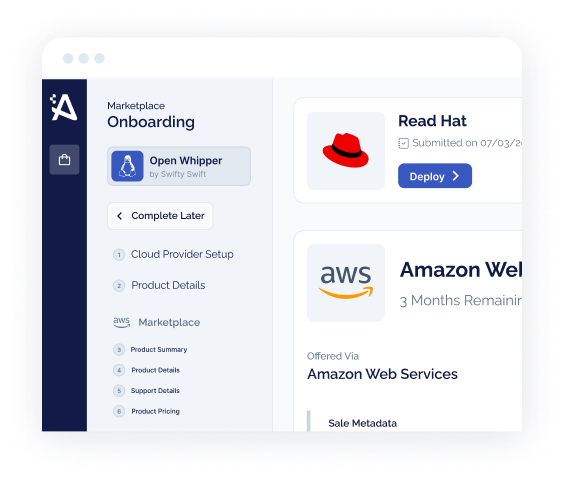
This is exactly why teams use Automatum — to give VPs of Partnerships visibility and control across all three clouds from a single platform.
The five operational pillars we described above — listing management, private offers, co-sell pipeline, metering and billing, and compliance — are precisely what Automatum automates. Instead of your team spending hours in three different cloud consoles creating private offers, reconciling billing data, and manually submitting ACE opportunities, Automatum consolidates the entire workflow.
The result: you stop managing marketplace plumbing and start managing marketplace strategy. Your time goes to PDM relationships, sales enablement, and board-level reporting — not operational firefighting.
For a full marketplace platform comparison, we've published an independent evaluation of every major solution in the category.
- Review marketplace revenue vs target and pipeline coverage
- Audit co-sell opportunity registrations and win rates
- Assess multi-cloud listing coverage (AWS + Azure + GCP)
- Check sales comp alignment — are marketplace deals rewarded?
- Review committed spend capture rate across EDP/MACC/CUD
- Evaluate operations automation — time per private offer
- Meet with cloud provider PDMs for co-sell pipeline review
- Report marketplace metrics to leadership with attribution data
Ready to close the Listing-to-Revenue Gap?
Join the VPs of Partnerships who manage all three cloud marketplaces from one platform.
Book a Working Session →Frequently Asked Questions
Common questions about cloud marketplace management for partnership leaders.
What does a VP of Partnerships need to know about cloud marketplaces?
Cloud marketplaces are procurement channels, not product directories. Your role is building the co-sell motion, managing multi-cloud operations, and proving marketplace ROI to the board. The ISVs generating meaningful marketplace revenue treat it as an operating discipline with dedicated headcount, defined KPIs, and systematic co-sell engagement.
How long does it take to see marketplace revenue?
Most ISVs see their first transaction within 60-90 days of listing, but meaningful revenue (more than 10% of pipeline) typically takes 6-12 months of active co-sell engagement. The timeline depends on the strength of your co-sell motion, the size of your existing pipeline, and whether your sales team is trained to route deals through marketplace.
Should we list on all three cloud marketplaces?
Multi-cloud ISVs generate 10x more marketplace revenue than single-cloud (29% vs 3%, per Tackle). Start with the cloud where you have the strongest customer base and PDM relationship, then expand to the second cloud within 6 months. The operational complexity of multi-cloud is real, but the revenue case is overwhelming.
What's the biggest mistake in marketplace management?
Treating it as a side project. Companies that assign dedicated headcount and measure marketplace-specific KPIs consistently outperform those that bolt marketplace responsibilities onto existing partner roles. The Listing-to-Revenue Gap exists because most organizations underinvest in the operational infrastructure that turns a listing into a revenue channel.
Keep building your marketplace motion
Guides to help you scale cloud marketplace revenue as a partnership leader.