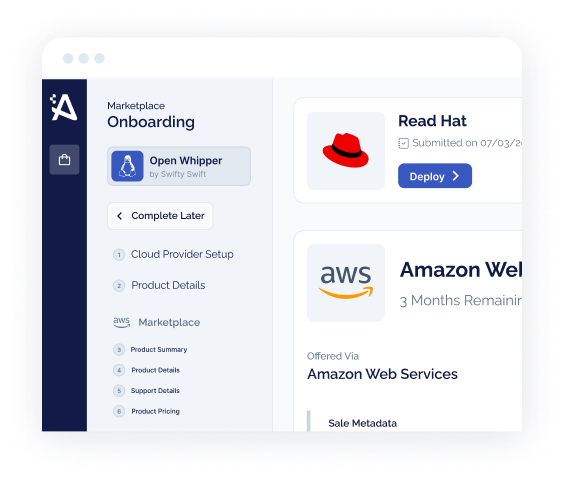





You have a $400K deal, the champion loves the product, but procurement asks if you’re on their cloud marketplace. Your public listing is a $2K/month tier. That’s the problem private offers solve.
Private offers let you maintain a public listing with standard pricing while transacting enterprise deals with fully custom terms through the same cloud marketplace procurement channel.
What Is a Private Offer?
A private offer is a customized marketplace listing visible and purchasable only by a specific customer account. It includes custom pricing, contract terms, payment schedules, and bundled pricing — all delivered through the same trusted procurement channel as your public listing.
Think of it this way: your public listing is the storefront window. A private offer is the back-office deal you negotiate with an enterprise buyer who needs something different from what’s on the shelf.
Private Offers on AWS Marketplace
Standard Private Offers
Specify a customer’s AWS account ID, set custom pricing, set an expiration date, and send. The customer sees it in their subscriptions view and can accept with a few clicks. It’s the simplest path from negotiation to closed deal.
If you want a faster path through the analysis, the Marketplace Fee Calculator is free and takes under five minutes to model your net revenue across AWS, Azure, and GCP fee structures.
Channel Partner Private Offers (CPPO)
CPPO enables channel partners to create offers on behalf of an ISV. The partner adds their margin, the ISV sets the wholesale price. This is the highest-use offer type for channel-driven GTM — your partners can close deals without you touching the marketplace portal.
Flexible Payment Scheduler
Installment billing for annual or multi-year contracts. A $500K upfront payment becomes a $42K monthly expense — matching the buyer’s budget cycle and removing the biggest objection in enterprise procurement.
Private Offers on Azure Marketplace
Azure uses Private Plans — restricted to specific tenant IDs. Notable difference: the customer must navigate to your listing to see the private plan. There’s no auto-notification, so always send the buyer direct instructions on where to find and accept the offer.
Multiparty Private Offers (MPOs)
MPOs are Azure’s equivalent of AWS CPPO. ISV, CSP partner, and enterprise customer transact together within the marketplace. MPOs simplify complex three-way deal structures that would otherwise require separate contracts with each party.
Private Offers on GCP Marketplace
GCP uses Private Plans restricted to customer project or billing accounts. The model is similar to Azure’s. Partner-initiated offers are emerging but less mature than AWS CPPO.
One advantage unique to GCP: marketplace purchases count toward Committed Use Discount (CUD) commitments. This creates a powerful procurement incentive for enterprise buyers with existing Google Cloud spend — your software effectively draws down money they’ve already committed.
How Private Offers Compare Across Clouds
| AWS | Azure | GCP | |
|---|---|---|---|
| Offer Type | Private Offer | Private Plan | Private Plan |
| Buyer ID | AWS Account ID | Azure Tenant ID | Project / Billing Account |
| Channel Offers | CPPO (mature) | MPO (growing) | Emerging |
| Commit Drawdown | EDP | MACC | CUD |
| Buyer Notification | Auto + manual | Manual only | Manual only |
The Private Offer Lifecycle
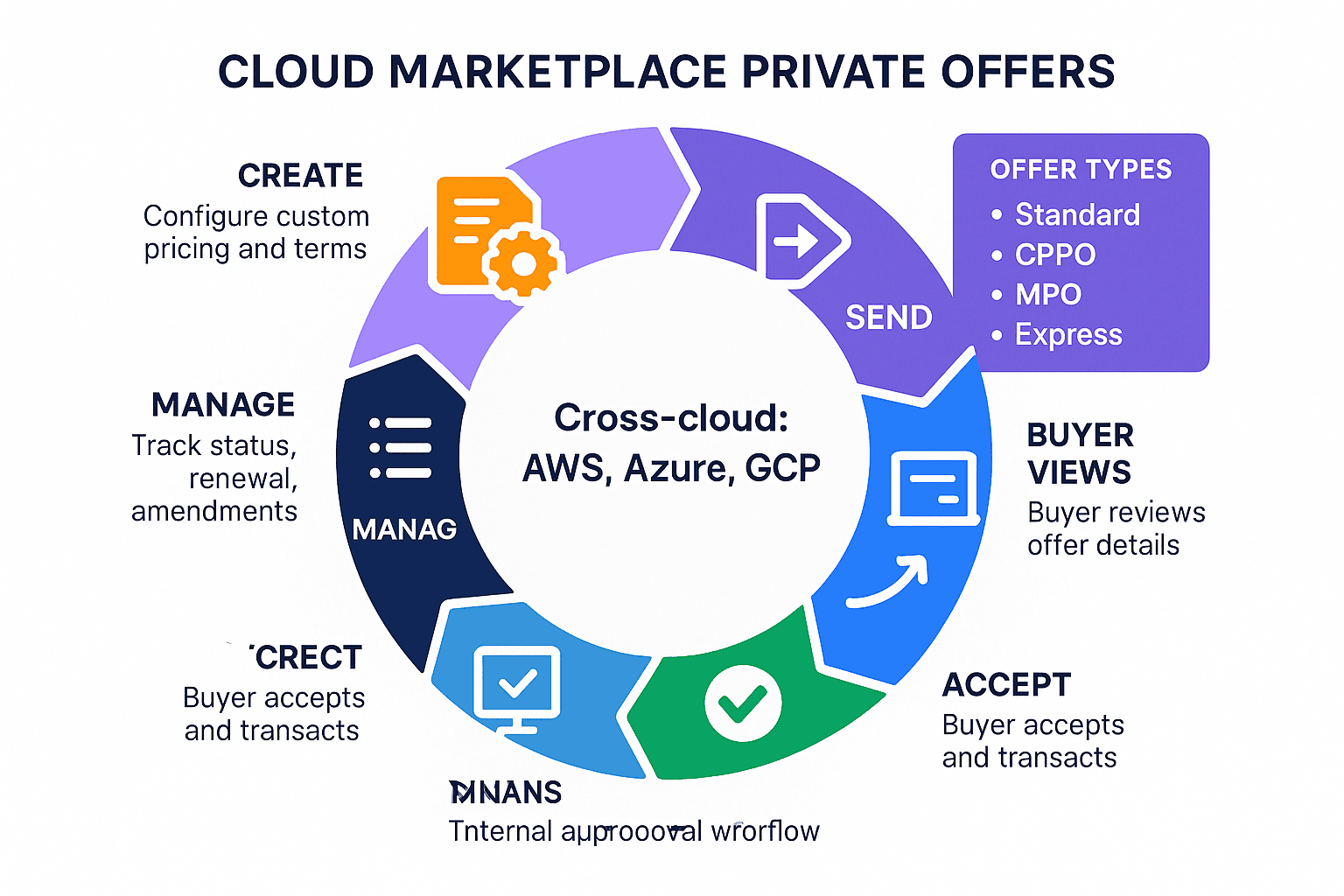
- Negotiate commercially first. Don’t negotiate through the offer itself. Agree on pricing, terms, and duration before creating anything in the marketplace portal.
- Create the offer. Build it in your marketplace portal with the agreed terms. Double-check the buyer account ID, pricing dimensions, and expiration date.
- Notify the customer. Send the buyer direct instructions on where to find and accept the offer. On Azure and GCP, there is no auto-notification.
- Customer accepts. Your system must respond to activation events via the marketplace API. Handle provisioning, entitlement checks, and welcome flows.
- Manage the subscription. Track renewals, handle amendments, and monitor consumption. Keep your CRM in sync with marketplace entitlement state.
- Renewal. Start the renewal conversation 90 days before expiration. Create a new private offer with updated terms well before the deadline.
Best Practices from 60+ ISV Listings
- Set realistic expiration windows. 30–60 days minimum gives procurement teams time to complete internal approvals.
- Use CPPO when you have channel partners. It’s the highest-use offer type for partner-driven deals.
- Standardize deal desk templates for offer configuration to reduce errors and speed up turnaround.
- Track time-to-accept as a sales metric. It reveals procurement friction and helps forecast accurately.
- Introduce marketplace during discovery, not at close. Buyers need time to align internal processes.
Automatum gives you a single interface for private offers across AWS, Azure, and GCP.
Book a Working Session →Frequently Asked Questions
Straight answers to the questions ISVs, channel partners, and enterprise buyers usually ask about private offers.
What is a private offer on a cloud marketplace?
A private offer is a customized marketplace listing visible only to a specific customer account. It includes custom pricing, contract terms, and payment schedules while transacting through the same trusted cloud marketplace procurement channel.
How do AWS private offers work?
On AWS Marketplace, sellers specify a customer’s AWS account ID, set custom pricing and terms, and send the offer. The customer sees it in their subscriptions view and can accept with a few clicks. CPPO enables channel partners to create offers on the ISV’s behalf.
Can private offers draw down committed cloud spend?
Yes. Private offer purchases on AWS count toward EDP commitments, Azure purchases count toward MACC, and GCP purchases count toward CUD commitments. This makes private offers a powerful procurement incentive for enterprise buyers.
What is the difference between CPPO and standard private offers?
Standard private offers are created directly by the ISV for the end customer. CPPO, or Channel Partner Private Offers, allow authorized channel partners to create offers on the ISV’s behalf, adding their own margin while the ISV sets the wholesale price.
How long should a private offer expiration window be?
Best practice is 30–60 days minimum. Enterprise procurement teams need time for internal approvals, legal review, and budget allocation. Too-short windows create unnecessary friction and can kill otherwise closed deals.
Keep building your marketplace motion
Practical guides for private offers, partner-led selling, and multi-cloud marketplace transactions.