



Your Customers Are Already Shopping There — Are You Listed?
Imagine a procurement channel where your customers can discover your product, evaluate it, trial it, purchase it, and renew it — all without your finance team touching a single invoice, and without your legal team negotiating another vendor agreement from scratch. Now imagine that same channel lets buyers apply their pre-committed cloud spend, meaning your deal can close in days instead of months.
That channel exists. It is called a cloud marketplace, and in 2026 it is no longer optional for software companies that want to compete.
AWS Marketplace, Microsoft Azure Marketplace, and Google Cloud Marketplace have collectively moved beyond $45 billion in annual software transactions, with growth outpacing traditional software distribution channels by a significant margin. Yet the majority of independent software vendors (ISVs) still treat marketplace as an afterthought — a secondary channel they will get to someday.
This guide is for the VP of Sales or Head of Partnerships who wants to understand exactly what cloud marketplaces are, how they work, and why getting listed is one of the most leveraged distribution decisions your company can make in 2026.
What Is a Cloud Marketplace?
A cloud marketplace is a curated digital catalog managed by a major cloud provider — Amazon Web Services, Microsoft Azure, or Google Cloud Platform — where independent software vendors list their products for sale. Buyers (enterprises, mid-market companies, and startups) use these marketplaces to discover, evaluate, and purchase software that integrates tightly with their existing cloud infrastructure.
If you want a faster path through the analysis, the Marketplace Readiness Assessment is free and takes under five minutes to assess your readiness before investing in listing work.
Think of it as an enterprise app store, but for serious B2B software: security tools, data platforms, DevOps tooling, AI/ML services, SaaS applications, and everything in between. The key distinction from a traditional app store is the financial infrastructure underneath.
Cloud marketplace transactions flow through the cloud provider's billing system, which means they draw down on a buyer's existing committed cloud spend agreements.
The Three Major Cloud Marketplaces
AWS Marketplace
Launched in 2012, AWS Marketplace is the most mature and highest-volume marketplace in the category. It hosts over 14,000 software products across dozens of categories, serving hundreds of thousands of active buyers.
AWS Marketplace is particularly strong in infrastructure software, security, data and analytics, and DevOps tooling.
For sellers, AWS offers listing types ranging from SaaS subscriptions to AMI-based products to professional services. The marquee co-sell program is ISV Accelerate, which gives qualified ISVs access to AWS's global field sales team for joint pursuit of enterprise deals.
Microsoft Azure Marketplace
Azure Marketplace is the natural home for software companies whose buyer base is Microsoft-centric — enterprises running Windows Server, Office 365, Dynamics, or Azure-native services. It is deeply integrated with Microsoft's commercial channel, and the IP Co-Sell program creates strong incentives for Microsoft's own sales force to recommend ISV solutions alongside Azure services.
Azure Marketplace is also notable for the strength of its committed spend mechanism, the Microsoft Azure Consumption Commitment (MACC), which allows buyers to count marketplace purchases against their Azure spending obligations.
Google Cloud Marketplace
Google Cloud Marketplace (formerly Cloud Launcher) has grown substantially as GCP has matured into a serious enterprise platform. It is particularly strong in data, AI, and analytics — categories where Google's own infrastructure differentiation resonates most.
The co-sell program is ISV Solution Connect, and buyers can apply their Committed Use Discounts (CUD) toward marketplace purchases.
How Cloud Marketplaces Work: The Mechanics
Understanding the mechanics of a marketplace transaction helps you appreciate why buyers love them and why sellers who are not listed are leaving revenue on the table.
Listing and Fulfillment
As a seller, you create a product listing on one or more marketplaces. Depending on your product type, this listing describes your software, pricing, supported regions, and contract terms.
For SaaS products, the marketplace acts as a billing intermediary — the buyer subscribes through the marketplace, and you fulfill the product directly. For AMI-based products (AWS), the software itself runs in the buyer's cloud environment.
Pricing Models
Cloud marketplaces support a range of pricing structures:
- Subscription pricing — monthly or annual flat-rate charges, common for SaaS
- Usage-based pricing — charges tied to consumption metrics (API calls, data processed, users)
- Contract pricing (Private Offers) — custom pricing negotiated directly with a specific buyer, processed through the marketplace
- Free trials — limited-duration free access to drive product-led growth
Private Offers: The Enterprise Deal Layer
Private Offers are one of the most important — and most misunderstood — features of cloud marketplaces. A Private Offer is a customized pricing agreement between you and a specific buyer, delivered through the marketplace.
The deal terms (price, duration, payment schedule) are negotiated off-platform, but the transaction closes on-platform.
This means enterprise deals that previously required 60-90 days of procurement cycles can be structured as marketplace transactions, dramatically compressing time-to-close. The buyer gets their negotiated price.
You get marketplace visibility and committed-spend eligibility. Everyone wins.
Committed Spend: The Biggest Unlock in B2B Software Sales
To understand why cloud marketplaces are transforming software sales, you need to understand committed cloud spend.
Enterprise buyers routinely sign large spending commitments with cloud providers in exchange for pricing discounts. AWS calls this the Enterprise Discount Program (EDP). Microsoft calls it MACC.
Google calls it CUD. Under these agreements, a company commits to spending a certain amount with the cloud provider over a multi-year period — sometimes $10M, $50M, or hundreds of millions of dollars.
Here is the critical insight: software purchased through a cloud marketplace counts toward these spending commitments. This changes the buyer's economic calculus entirely.
If a buyer has $8M left on their Azure MACC obligation by year end, and they can purchase your $400K SaaS product through Azure Marketplace, they are not spending new budget — they are deploying budget they have already committed. From the buyer's perspective, the effective cost of your product may be zero, or even negative, because buying it helps them avoid penalties for under-spending their commitment.
This dynamic explains why enterprise deal cycles on marketplace can be dramatically shorter than direct sales. Procurement friction disappears when the purchase mechanism is already in place.
Why Marketplace Matters for Sellers
Reduced Procurement Friction
Traditional enterprise software sales involve multiple stakeholders, lengthy vendor assessments, legal reviews, and procurement processes that can stretch for months. Marketplace-listed products have already been vetted by the cloud provider, which means the buyer's security and procurement teams have a pre-approved pathway to purchase.
The time-to-close on marketplace-influenced deals is consistently shorter than purely direct deals.
Co-Sell Use
Each of the major cloud providers operates a co-sell program that allows qualified ISVs to engage with the provider's own field sales team on joint opportunities. This is not a side benefit — it is one of the most powerful distribution advantages available to software companies.
AWS has tens of thousands of sales professionals actively selling to enterprises. ISV Accelerate gives you the ability to get your product in front of those enterprise buyers through joint pursuit.
New Revenue Channels
Many enterprise buyers specifically prefer marketplace-first purchasing for operational reasons: single vendor billing, simplified provisioning, audit-friendly procurement trails. A company that is not listed on marketplace is simply invisible to these buyers at the moment of consideration.
Global Distribution
AWS, Azure, and GCP collectively have buyers in virtually every country. A marketplace listing is, in effect, an instant global distribution capability. You set your pricing, define your supported regions, and buyers anywhere in the world can find and purchase your product.
Why Marketplace Is Still Underutilized — And the Cost of Waiting
Despite the obvious advantages, most ISVs delay marketplace listing for one reason: it is technically complex to implement. A proper marketplace integration requires building against cloud provider APIs for metering, handling subscription lifecycle events (subscribe, unsubscribe, renewal), managing billing reconciliation, and meeting fulfillment SLA requirements.
The engineering effort for a full multi-cloud integration can run 3-6 months and cost $150,000-$300,000 or more in engineering time.
The companies that delay listing are not saving money — they are giving their listed competitors a co-sell advantage, a procurement advantage, and a buyer accessibility advantage that compounds with every passing quarter.
The Automatum Approach
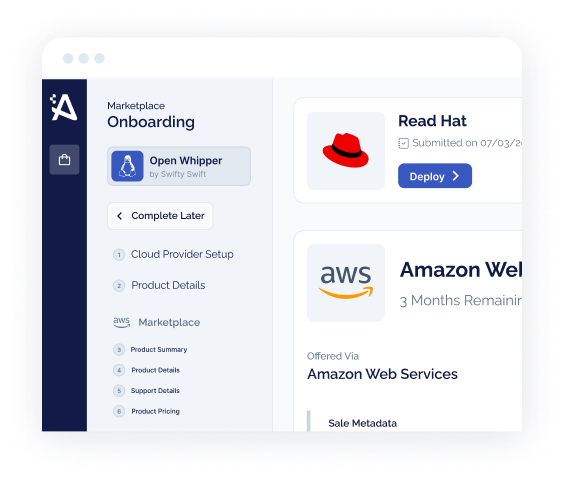
This is exactly the problem Automatum was built to solve. Automatum is a cloud marketplace GTM platform that handles the technical integration work — API connections, metering infrastructure, billing reconciliation, private offer workflows — so that software companies can list on AWS, Azure, and GCP without a single line of engineering effort from their internal team.
With over 60 successful listings facilitated, Automatum has compressed what typically takes an engineering team 3-6 months into a structured, guided process managed entirely through the platform. Your sales and partnerships team defines the listing. Automatum handles the rest.
The result is that your team can focus on what actually drives revenue: co-sell motions, private offer negotiations, and partner relationships — not debugging webhook handlers or reconciling metering discrepancies.
Getting Started
Cloud marketplaces are not a future channel. They are the present channel for serious enterprise software distribution. The $45B+ market is growing, committed spend pools are expanding, and buyers are increasingly defaulting to marketplace-first procurement.
The question for software companies in 2026 is not whether to list on cloud marketplace. It is how fast you can get there, and which platforms your customers are already buying from.
If you are a VP of Sales or Head of Partnerships evaluating your marketplace strategy, start with where your customers live. If your enterprise buyers are AWS-centric, AWS Marketplace is your first listing.
If they are Microsoft shops, Azure is the priority. If you are in data and AI, GCP may be your fastest path to revenue.
Whatever your starting point, the mechanics work the same way: list your product, enable committed-spend eligibility, activate co-sell, and let buyers find you through the channel they already trust.
Ready to List Without the Engineering Headache?
Automatum helps software companies list on AWS, Azure, and Google Cloud Marketplace with no engineering effort required. If your team is ready to open the marketplace channel — or if you want to understand exactly what listing would look like for your product — talk to the Automatum team.
We have facilitated 60+ listings and can tell you within a single conversation what your fastest path to market looks like.
Automatum simplifies cloud marketplace operations across AWS, Azure, and GCP.
Book a Working Session →Frequently Asked Questions
Common questions about the topics covered in this guide.
What is a cloud marketplace?
A cloud marketplace is a curated digital catalog managed by a major cloud provider, such as AWS, Azure, or GCP, where software vendors list their products for sale. Buyers use these marketplaces to discover, evaluate, and purchase software that integrates with their cloud infrastructure.
How does committed cloud spend affect marketplace purchases?
Enterprise buyers sign large spending commitments with cloud providers in exchange for discounts. Software purchased through a cloud marketplace counts toward these commitments, effectively making the purchase free from the buyer's budget perspective since the money is already committed.
What are private offers on cloud marketplaces?
Private offers are customized pricing agreements between a seller and a specific buyer, delivered through the marketplace. The terms are negotiated off-platform but the transaction closes on-platform, compressing enterprise deal cycles from months to weeks.
Which cloud marketplace should I list on first?
Start where your customers run their primary workloads. If your buyers are AWS-centric, list on AWS Marketplace first. Microsoft shops should prioritize Azure. Data and AI companies often find GCP is their fastest path to marketplace revenue.
Keep building your marketplace motion
Go deeper into cloud marketplace strategy and platform-specific guides.