
The line item everyone ignored
Synthrex's AWS bill had climbed from $8K to $49K a month over three years. That part made sense — customers tripled, the data pipeline grew, the business was healthy. What didn't make sense was how much of it was just… unnecessary.
Marcus R., VP of Engineering, had known it for a while. "Every quarter it was the same thing," he says. "I'd look at the AWS bill, think yeah we should sort that out, and then we'd have a hiring push or a big customer onboarding or whatever, and it would just not happen. Three years in a row."
Finance had flagged Reserved Instances as a savings opportunity before. Engineering had actually started the analysis twice — and abandoned it both times once they got into the weeds. Which instance families, which regions, what terms, how to account for customers that suddenly scale up. It was a real project with real risk, and it kept losing to other priorities.
"We knew we were overpaying. We just couldn't figure out a safe way to fix it without someone owning it full-time."
— Marcus R., VP Engineering, SynthrexMeanwhile the bill kept climbing. Their workload had been stable enough to commit against for at least eighteen months. They just never did.
One call, and suddenly the numbers were very clear
Synthrex was already working with Automatum on their AWS Marketplace listing. When the cost optimisation service came up in conversation, Marcus agreed to a call more out of curiosity than expectation. "I figured it would be the usual — here's a rough estimate, here's a proposal, let's scope something. I wasn't expecting much."
What came back was a line-by-line breakdown of every commitment opportunity across all three of their AWS accounts. Not rough estimates — specific numbers, specific savings, specific commitment types for each service family. "I'd never seen it laid out that clearly. We spent the first ten minutes just going through the RDS numbers because I genuinely didn't believe them."
The analysis covered the full picture:
- EC2 $28,400 / month on-demand Three instance families with predictable 24/7 usage. Saving available: 38% via Compute Savings Plan with 30-day terms.
- RDS $11,200 / month on-demand PostgreSQL and Aurora clusters running continuously for 18+ months. Saving available: 43% via 1-year Reserved Instances with risk protection.
- ECS $6,800 / month on-demand Fargate tasks with steady baseline load. Saving available: 36% via Compute Savings Plan.
- Other $2,600 / month remaining services ElastiCache, CloudFront, data transfer. Partial optimisations available, lower priority.
The thing that had always blocked them — gone
Every time Synthrex had looked at this before, the same objection killed it: lock-in risk. They had customers who could scale up fast, and no guarantee their compute needs would stay stable. Committing to a year or more of Reserved Instance capacity meant that if a big customer churned, they'd be paying for idle compute with no way out.
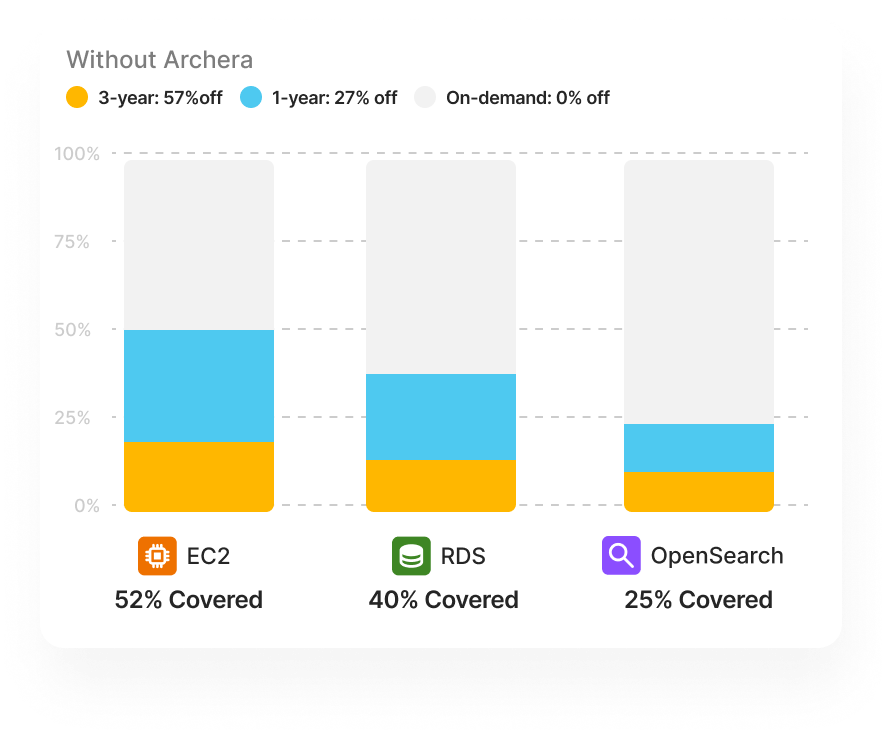
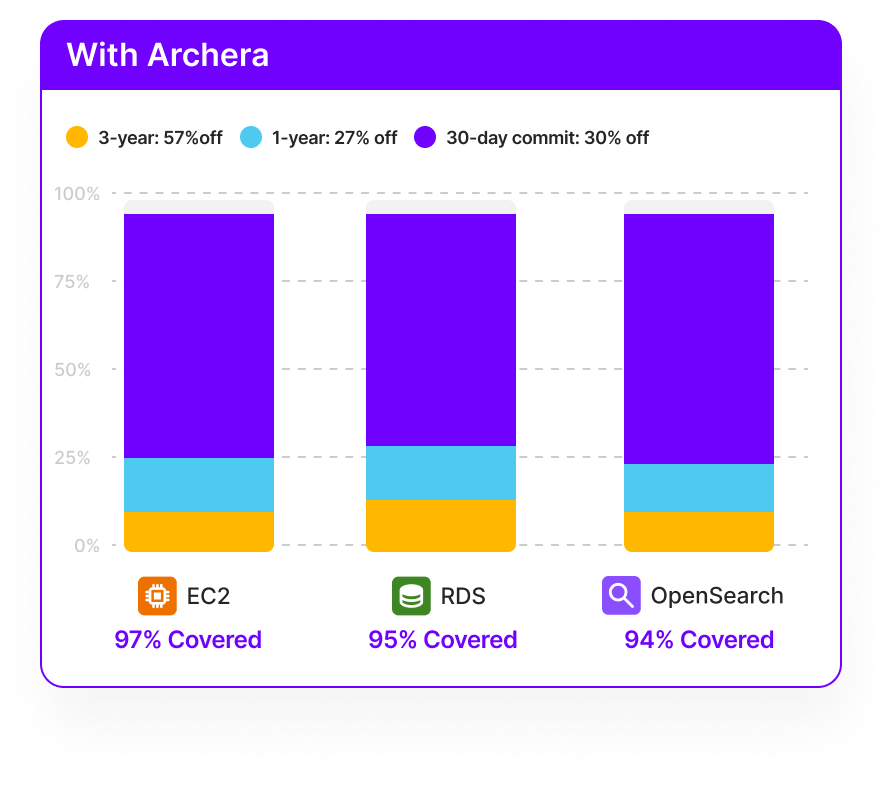
The Automatum programme handled both sides of that problem. Commitment terms start from 30 days — not one to three years. And unused Reserved Instance capacity is covered through the Advanced Partner structure, so the downside risk is removed.
"Look, those were the two things that had always stopped us," Marcus says. "The short terms meant we weren't gambling on 12 months of perfect stability. The risk coverage meant we could commit at a much higher percentage than we'd ever have done ourselves. There wasn't really a reason to say no."
"Short commitment terms and no downside on unused capacity — those two things together removed every objection we'd had for three years."
— Marcus R., VP Engineering, SynthrexNothing changed. Except the bill.
No refactors. No rightsizing sprint. No spot instance migration. The engineering team put in zero hours. The infrastructure was identical the day after the commitments went live.
The only thing that changed was how AWS billed for it — on-demand rates swapped for committed pricing, with a programme that covers the unused portion. Same servers, lower number at the bottom of the invoice.
| Item | Before | After |
|---|---|---|
| Monthly AWS compute bill | $49,000 | $28,910 |
| EC2 commitment coverage | 0% | 91% |
| RDS commitment coverage | 0% | 87% |
| Engineering hours spent | ~40 hours (previous failed attempts) | 0 hours |
| Risk on unused commitments | N/A (never committed) | Covered |
| Time from analysis to first saving | Never resolved | 28 days |
Day 28: the invoice lands
Commitments went live about two weeks after the analysis. Marcus says he opened the next AWS invoice half-expecting it to look normal. "It was $20K lower. I stared at it for a second and then forwarded it to our CFO. She replied in about 30 seconds — 'Wait, is this right?' Yeah. It's right. And it's going to look like that every month."
The $240K annual saving worked out to roughly 13% of their total operating budget at the time. For a Series B company watching burn rate, that's not a rounding error — that's headcount. They approved two senior engineering hires the same quarter.
What Marcus tells other engineering leaders
He's passed the recommendation on to a couple of founders he knows. The pitch is short: "If you've been on AWS more than 18 months and you haven't looked at your commitment structure, you're almost certainly leaving 30% on the table. I know because we did exactly that for three years."
The thing he keeps coming back to is how small the actual effort was. "We'd been treating it like a big project. Something we'd get to eventually when we had bandwidth. It wasn't a project. It was a 45-minute call and then two weeks of Automatum doing their thing."
"We told ourselves we'd fix it when we had time. Turns out it didn't take any of our time at all."
— Marcus R., VP Engineering, SynthrexHow the process worked
- 1 45-minute discovery call Automatum reviewed Synthrex's Cost Explorer data. No access to infrastructure required — read-only cost reports were sufficient.
- 2 Savings plan delivered within 48 hours A line-by-line commitment recommendation covering EC2, RDS, and Fargate with conservative and optimistic saving scenarios for each service.
- 3 Commitments activated in two weeks Purchases made directly in Synthrex's AWS organisation. All commitments visible in the AWS console. Terms starting from 30 days with risk coverage on unused capacity.
- 4 First reduced bill arrived day 28 $20,090 saving in the first billing cycle. Ongoing monitoring and quarterly reviews included.
See what your AWS bill could look like
Book a free 45-minute review. We analyse your spend, identify the savings, and give you a concrete plan — before you commit to anything.
Get a free cost reviewNo obligation · No engineering work required · Results in 48 hours
