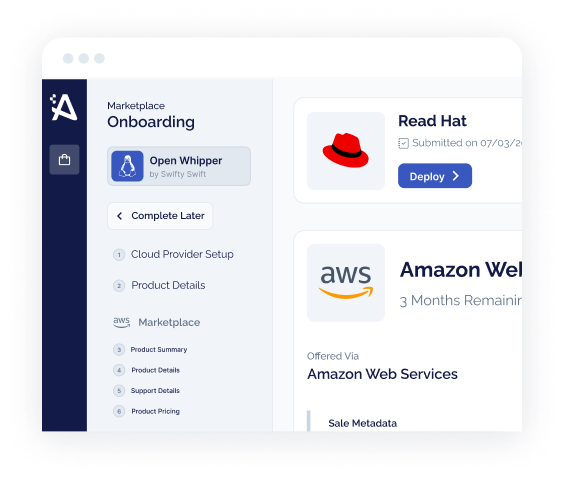
- Automatum is a full-service managed platform — Automatum's team does the work alongside yours. Clazar is AI-native self-serve software — your team operates it independently.
- Both cover AWS, Azure, and GCP. Automatum also supports RedHat Marketplace. Clazar's pricing requires a sales call; Automatum publishes flat pricing with no revenue share.
- Automatum has facilitated 80+ cloud marketplace listings. Clazar is a newer entrant with a strong content presence but a shorter live customer track record in operations.
- If you want speed, no engineering involvement, and a team that has done this before — Automatum wins. If you want self-serve AI tooling and have internal resources to operate it — Clazar is worth evaluating.
Why This Comparison Matters
Automatum vs Clazar is a comparison that comes up more often than you might expect. Clazar has built serious content authority in the cloud marketplace space — their research gets cited across the industry, including in our own posts. They are building an AI-native platform that makes real claims about speed and automation. So this deserves a real comparison, not a dismissive paragraph.
We have skin in this game. We want you to choose Automatum. But the only way to earn that choice honestly is to give you an accurate picture of what each platform actually is, not just what their marketing says.
The short version: Automatum and Clazar are solving the same problem — helping ISVs get listed, transact, and grow revenue on cloud marketplaces — but with fundamentally different models. One is a managed service with a team behind it. One is AI-native software you operate yourself.
That distinction drives almost every other difference in this comparison.
Automatum vs Clazar: Quick Comparison
| Capability | Automatum | Clazar |
|---|---|---|
| Service Model | Managed service — Automatum team operates alongside yours | Self-serve SaaS — your team operates the platform |
| Pricing Model | Flat subscription, no revenue share, published on website | Subscription — contact for pricing |
| Marketplaces Supported | AWS, Azure, GCP, RedHat | AWS, Azure, GCP |
| CRM Integrations | Salesforce + HubSpot | CRM integrations available (varies by plan) |
| Co-Sell Management | AWS ACE + Azure IP Co-Sell in-platform | Co-sell support available |
| Private Offers | Full lifecycle: create, track, amend, resend | Private offer support available |
| Engineering Effort | Zero — no-code listing and management | Minimal — AI-assisted workflow reduces engineering burden |
| Time to First Listing | Dependent on listing complexity and cloud program | Claims fast onboarding; varies by listing complexity |
| AI Features | Not the focus — people and process-first | AI-native platform — core product differentiator |
| Track Record | 80+ listings across AWS, Azure, GCP, RedHat | Newer entrant; growing customer base |
| RedHat Marketplace | Supported | Not publicly documented |
| Founded | 2022 | More recent entrant |
What Is Clazar?
Clazar is an AI-native cloud marketplace platform designed to help ISVs list, transact, and manage their marketplace presence across AWS, Azure, and Google Cloud. They have built a strong content presence — their research reports on marketplace adoption patterns are widely cited — and they position the platform as a faster, more automated path to marketplace revenue.
Their content operation is one of the best in the space. Clazar publishes the stats that the broader marketplace ecosystem quotes: the 89% listing rate, the 22% revenue generation rate, the 60% of SaaS companies acquiring net-new customers through marketplace. If you have read anything about cloud marketplace in the last year, you have probably read a Clazar stat.
Clazar's AI-native UX, strong content authority, and clean product positioning make them a serious option for ISVs with internal ops capacity. Their research arm gives them genuine credibility in the market.
The platform focuses on listing automation, transaction management, and co-sell workflows across the three major cloud providers. Their AI-first approach aims to reduce the manual work involved in keeping listings current, managing private offers, and tracking co-sell opportunities.
Pricing is not published — you will need to get on a sales call to understand what a Clazar engagement costs. Based on publicly available information, Clazar uses a subscription model.
What Is Automatum?
Automatum is a cloud marketplace managed service. We cover AWS, Azure, Google Cloud, and RedHat Marketplace. We have facilitated 80+ marketplace listings across those four platforms.
The key distinction from Clazar — and from most other platforms in this category — is that Automatum is not just software. It is a service. When you work with Automatum, our team does the listing work alongside yours: configuring the listing, going through marketplace review, setting up metering, managing co-sell workflows, and troubleshooting the things that break.
We also have a platform layer that connects to your CRM (Salesforce or HubSpot), tracks private offer lifecycle, and gives your sales team visibility into marketplace activity without leaving their existing workflow.
Our pricing is flat. We do not take a percentage of your marketplace revenue. The bill stays the same whether you close $100K or $5M through marketplace in a given year. See pricing details here.
"We evaluated Tackle, Clazar, and Automatum. Automatum won because of their white-glove onboarding and the fact that we were live on all three clouds within two weeks. The ROI was obvious by month three."
The Fundamental Difference: Managed Service vs Self-Serve Software
This is the decision that determines whether Automatum or Clazar is right for you. Everything else — pricing, timelines, AI features — is secondary to this.
Clazar is software. You get access to the platform. Your team configures it, operates it, learns the co-sell workflow inside it, and maintains it as the cloud provider programs change. The AI capabilities reduce friction, but someone on your team is still responsible for what happens inside the platform.
Automatum is a managed service. You get access to the platform AND a team that has done 80+ of these before. When AWS changes its FTR requirements, Automatum catches it. When your Azure listing stalls in review, Automatum follows up. When your sales team asks why a private offer has not closed, Automatum investigates.
The right question is not "which software is better" — it is "how much internal capacity do we have to operate a marketplace motion?"
If you have a dedicated marketplace operations person or a partnerships team that can own the day-to-day, self-serve software gives you more control and potentially lower cost at scale. Clazar is worth serious evaluation in that scenario.
If your team is stretched — if partnerships is one of seven things your VP Sales is managing, if your engineers are fully allocated to product — the managed service model is not a luxury. It is the difference between marketplace becoming a real revenue channel and it sitting dormant after a promising launch.
- You own every operational decision
- Learning curve on marketplace program rules
- Internal bandwidth required to maintain listings
- You identify and escalate issues yourself
- Team with 80+ listing track record behind you
- Proactive issue identification and escalation
- No internal bandwidth required for operations
- You focus on selling; we handle the mechanics
Marketplace Coverage: AWS, Azure, GCP — and RedHat
Both Automatum and Clazar cover the three major cloud marketplaces: AWS Marketplace, Azure Marketplace (Microsoft commercial marketplace), and Google Cloud Marketplace.
For most ISVs, those three are sufficient. But if your buyers include enterprises running OpenShift or RHEL-based infrastructure, RedHat Marketplace is a meaningful channel — particularly in telecom, government, and regulated industries.
Automatum supports RedHat Marketplace natively. Based on publicly available information, Clazar has not documented RedHat Marketplace support. If RedHat is relevant to your go-to-market, this is a direct differentiator.
Enterprise multi-cloud adoption is at 89% (Clazar research, 2025). Buyers are on multiple clouds. Choosing a platform that cannot follow you to all four marketplaces creates operational debt as you scale.
Pricing: Flat vs Contact for Pricing
Automatum publishes pricing on our website. Flat subscription, no revenue share, tiers based on scope. The only number that changes as you grow your marketplace revenue is your marketplace revenue — not your platform bill.
At $1M in annual marketplace transactions, a revenue share model at 3–5% costs $30K–$50K on top of the base platform fee. At $5M, that becomes $150K–$250K in platform cost on top of your base. Automatum's flat pricing stays the same at both levels.
Clazar's pricing is not published. You will need to contact their sales team for a quote. Based on available public references, Clazar uses a subscription model — but the specifics require a sales conversation. We cannot make a direct comparison on exact numbers because Clazar has not made them public.
Note: Illustrative comparison showing cost behaviour of flat vs revenue-share models. Clazar does not publish pricing; their actual model may differ.
Feature-by-Feature: Co-Sell, Private Offers, CRM
Co-Sell Workflow
Co-sell is where marketplace deals get large. AWS ISV Accelerate and Azure IP Co-Sell put your product in front of cloud provider sales teams working active enterprise accounts.
Automatum provides in-platform co-sell management for AWS ACE and Azure IP Co-Sell referrals. The managed service layer means our team tracks opportunity status, follows up on stalled referrals, and flags when cloud provider timelines are slipping — tasks that fall to your partnerships team if you are using self-serve software.
Clazar offers co-sell support as part of their platform. The self-serve model means your team owns the workflow day-to-day.
Private Offers
Private offers are how enterprise marketplace deals close. Both platforms support private offer creation, tracking, and amendment across the major cloud marketplaces.
The difference is operational. With Automatum, your sales team creates a private offer request and our team handles the mechanics. With Clazar, your sales team operates the private offer workflow directly in the platform — which is faster if they learn the tool, but requires more ramp-up time and ongoing ownership.
CRM Integration
Automatum provides native integrations with both Salesforce and HubSpot. Marketplace deal data, private offer status, and co-sell opportunity updates flow into whichever CRM your sales team uses. No middleware, no CSV exports, no manual reconciliation.
Clazar offers CRM integrations. The specifics depend on the plan tier — check with their sales team for current Salesforce and HubSpot support details.
A significant share of ISVs in the sub-$50M ARR range — exactly the companies entering cloud marketplace most aggressively — run HubSpot, not Salesforce. A platform that routes marketplace data into your actual sales workflow changes adoption behaviour. One that requires a separate login gets ignored after six weeks.
When to Choose Clazar
Clazar is worth serious evaluation in specific circumstances.
You have internal marketplace operations capacity. If you have a dedicated partnerships manager, a RevOps team that can own the integration, and sales leadership that is bought in on marketplace motion — self-serve software gives you more control and can be more cost-effective at scale. Clazar's AI-native platform is designed for teams that want to own the workflow.
You want AI-native tooling as a core workflow. Clazar has positioned AI automation as a fundamental part of the product, not a feature layer. If AI-assisted listing management, automated workflow suggestions, and a modern product UX are important to your evaluation criteria, Clazar is building in that direction more explicitly than Automatum.
You are comfortable with a newer platform. Clazar is a newer entrant. If you are an early adopter who values product modernity and is willing to work with a platform still building its track record, that is a legitimate trade-off. Some buyers prefer working with a company that is highly responsive to customer feedback during their growth phase.
Your team wants to learn marketplace operations directly. The act of running your own platform builds institutional knowledge. If developing internal marketplace expertise is a strategic priority — so you can eventually operate independently without any external platform — self-serve software accelerates that learning curve.
When to Choose Automatum
Automatum is the right choice when the following conditions apply.
You do not have bandwidth for marketplace operations. If partnerships is one of many priorities, if your engineers are fully allocated to product, if your VP Sales does not have time to become a marketplace expert — the managed service model is not optional. It is the only model that gets you to revenue without burning internal resources on operational work your team is not equipped to do.
You need a proven track record. 80+ marketplace listings across AWS, Azure, GCP, and RedHat. We have seen the patterns that stall ISVs, the FTR failures that cost four weeks, the co-sell opportunities that sit dormant because no one followed up. That operational history is not in a platform — it is in the people who run it.
You want flat, predictable pricing. No revenue share. No surprises at renewal. When you close a $3M private offer through Azure Marketplace, your Automatum bill does not change. See our pricing page for current plan details.
You need HubSpot support. If your CRM is HubSpot, confirm with Clazar whether their HubSpot integration is available on your plan tier. Automatum's HubSpot integration is native across all plans.
You need RedHat Marketplace. If your buyers are in OpenShift or RHEL environments, Automatum covers RedHat natively. This matters in telecom, federal, and regulated industry verticals.
You want speed to first revenue. Automatum's managed service model eliminates the ramp-up time your team would spend learning a new platform — we have already done that learning across 80+ listings, so your team skips the trial-and-error phase entirely.
The Verdict
Clazar and Automatum are not competing for the same buyer. They are competing for ISVs in different situations.
Clazar is for the team that has the internal capacity to own marketplace operations and wants modern, AI-native software to do it efficiently. If that is you — if you have the people, the bandwidth, and the appetite to operate the platform yourselves — Clazar is worth serious evaluation.
Automatum is for the team that needs marketplace revenue but does not have the capacity to make it a primary operational focus. If you have a lean team, limited engineering bandwidth, or a partnerships motion that is still ramping up, the managed service model is not a premium — it is the pragmatic choice.
The 80+ listings we have facilitated are not a vanity metric. They represent 80+ times we have navigated FTR reviews, co-sell program rules, private offer mechanics, and the operational reality of getting an ISV from "interested in marketplace" to "generating marketplace revenue." That experience does not come with a self-serve software subscription.
For a broader comparison of all major platforms, see our Best Cloud Marketplace Platforms 2026 guide. For a direct look at how Automatum compares to the established market leader, read Automatum vs Tackle.
If you want to understand how Automatum could work for your specific situation, you can also use our marketplace ROI calculator to estimate the revenue potential of your listing before committing to any platform.
Ready to see how Automatum compares for your specific marketplace situation?
We will walk through your listing goals, timelines, and how the managed service model would work alongside your team.
Book a Working Session →Frequently Asked Questions
Common questions about Automatum vs Clazar.
What is the main difference between Automatum and Clazar?
The fundamental difference is the service model. Automatum is a managed service — Automatum's team operates the marketplace workflows alongside yours. Clazar is self-serve AI-native software — your team configures and operates the platform independently. Everything else, including pricing, timelines, and feature focus, flows from that core difference.
Does Clazar support HubSpot?
Clazar offers CRM integrations, but the specifics depend on the plan tier. You should confirm HubSpot availability directly with Clazar's sales team before committing. Automatum provides native HubSpot integration across all plans, alongside Salesforce.
How does Clazar pricing compare to Automatum?
Automatum uses flat subscription pricing with no revenue share, published on our pricing page. Clazar's pricing is not publicly listed — you need to contact their sales team for a quote. Based on available information, Clazar uses a subscription model, but the specifics are not public. If pricing transparency is important to your evaluation, that is a relevant factor.
Is Clazar a good option for early-stage ISVs?
Clazar can be a good option for early-stage ISVs that have internal capacity to operate the platform. If you have a partnerships manager or RevOps team who can own the marketplace workflow, self-serve software gives you control. If your team is lean and marketplace is not a primary operational focus yet, a managed service like Automatum typically gets you to revenue faster with less internal resource investment.
Which platform should I choose if I need to launch on multiple clouds?
Both platforms support AWS, Azure, and GCP. If you also need RedHat Marketplace — relevant for buyers in OpenShift and RHEL environments — Automatum supports it natively. Automatum's managed service model also handles multi-cloud complexity operationally, which is useful if your team does not have experience managing multiple cloud programs simultaneously.
Keep building your marketplace motion
More comparisons and platform guides to inform your evaluation.