



The Engineering Team Said It Would Take Six Weeks
It has been four months. The listing still is not live. Three engineers have touched the project.
The lead engineer who understood the AWS Marketplace Metering Service just gave their notice. And your competitor — who listed on marketplace eight months ago — just closed a $1.2M deal through ISV Accelerate that your sales team only heard about secondhand.
This is not a hypothetical. It is the most common story we hear from software companies who tried to build their cloud marketplace integration in-house before eventually deciding to use a platform.
What You Are Actually Building
The phrase cloud marketplace integration undersells the complexity. A complete, production-ready SaaS listing on AWS Marketplace requires: subscription registration webhooks, metering API integration (hourly usage reporting), entitlement service integration, subscription lifecycle event handling, fulfillment URL and onboarding flow, private offer creation workflow, and billing reconciliation.
The Realistic Engineering Cost
Single Marketplace (AWS)
- Initial build: 3–5 months, 2 senior engineers
- Engineering cost: $90,000–$183,000
- Total time to go-live: 5–8 months
- Ongoing maintenance: 0.25–0.5 FTE/year ($45K–$110K)
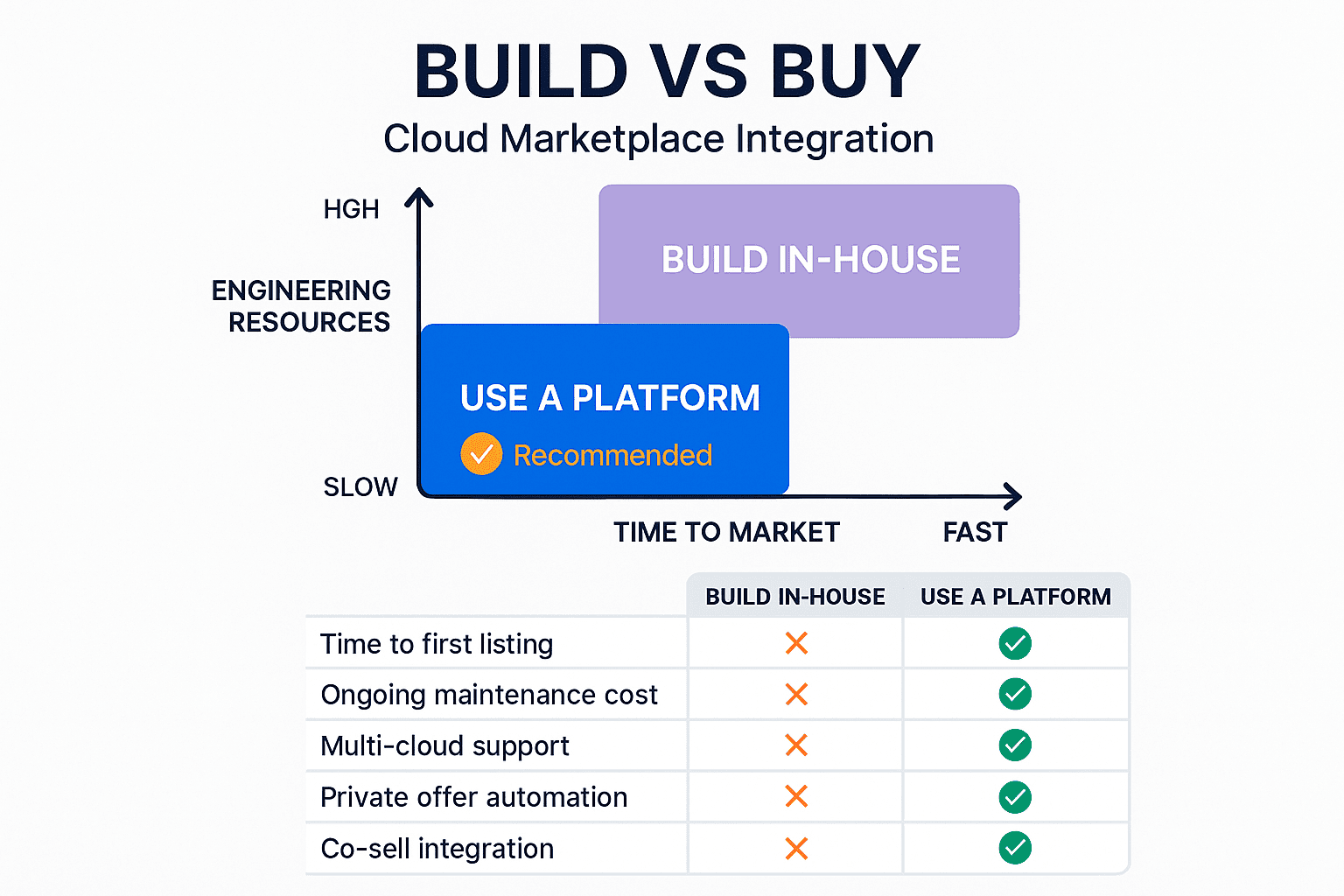
Three Marketplaces
- Initial build: 10–18 months
- Engineering cost: $300,000–$600,000+
- Ongoing maintenance: 0.75–1.5 FTE/year
Hidden Costs
Automatum simplifies cloud marketplace operations across AWS, Azure, and GCP.
Book a Working Session →Frequently Asked Questions
Common questions about the topics covered in this guide.
How long does it take to build marketplace integration in-house?
A full SaaS integration with metering, billing webhooks, and private offer support takes 3 to 6 months of senior engineering time per marketplace. Multi-cloud adds another 3 to 4 months per additional platform.
What does a marketplace management platform cost?
Platform costs typically run $2K to $10K per month, significantly less than the $150K to $300K per marketplace for in-house build plus $50K to $100K in annual ongoing maintenance.
When should I build marketplace integration in-house?
Build in-house only if marketplace operations are your core product or if you have very specific integration requirements that no platform supports. For most ISVs, marketplace is a sales channel, not a product.
What are the risks of building in-house?
API changes break integrations without warning. Metering bugs cause revenue leakage. Dedicated engineering headcount is needed indefinitely for maintenance, creating ongoing opportunity cost.
Keep building your marketplace motion
More resources for evaluating your marketplace integration approach.