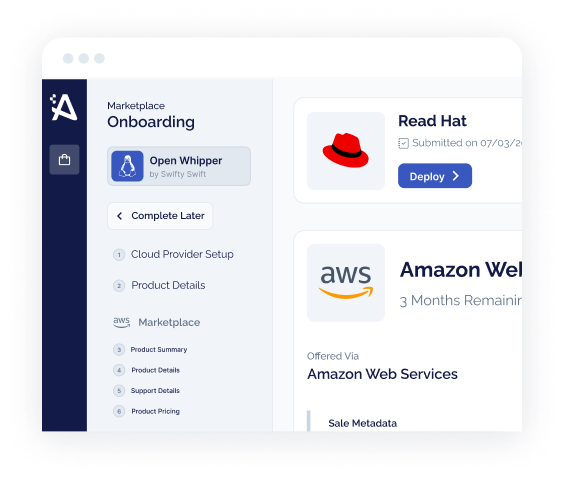

- “The AWS Marketplace API” is not one API — it is a family. The Catalog API manages products and offers; Metering and Entitlement handle usage and access at runtime; the Agreement, Discovery, Deployment, and Reporting APIs cover the rest (AWS Marketplace API Reference, 2026).
- The Catalog API is what powers the self-service publishing you already use in the AWS Marketplace Management Portal — the console is a client of the same API you can call yourself (AWS Marketplace Catalog API docs, 2026).
- A single
StartChangeSetrequest can chain up to 20 changes across one or more entities, which is how ISVs create a product and its offer in one automated step (AWS Marketplace Catalog API docs, 2026). - Build the runtime billing path first —
ResolveCustomer, entitlement, and metering — then automate listings and offers. Getting that order wrong is the usual reason an API project stalls.
Most sellers meet AWS Marketplace through the Management Portal: a web console for creating a listing, sending a private offer, and pulling a report. For one product, that is enough. It stops scaling the moment you are running dozens of private offers a quarter, carrying multiple products, or trying to make your listing move through the same release pipeline as your code. Underneath that console sits a set of public APIs that do most of what the console does — and a few things it can’t. This is the map, and the order to build in.
The console is a floor, not a ceiling
Here is the fact that reframes everything: per AWS, the Catalog API is what provides the self-service publishing capabilities inside the AWS Marketplace Management Portal (AMMP). When you edit a product in the console, you are using a client of the same API you can call directly (AWS Marketplace Catalog API docs, 2026). The console is not the product and the API a bolt-on — it is the other way around.
That matters because the console’s limits are human limits, not platform limits. Anything you do by hand — updating a description, cloning an offer, reconciling a report — is a candidate for automation, and AWS explicitly supports integrating the Catalog API with your product build or deployment pipelines to automate product updates (AWS Marketplace Catalog API docs, 2026).
- Every listing edit and offer is a manual, click-through task
- Listing changes live outside your version control and release process
- Private-offer volume is capped by how fast a human can fill forms
- Billing, entitlement, and reporting are stitched together by hand each month
- Product and offer changes run as code, in a pipeline, reviewable in a diff
- A single change set creates a product and its offer together
- Offer volume scales without proportionally scaling headcount
- Usage, entitlement, agreements, and reports flow through one integration
The AWS Marketplace API is a family, not a single endpoint
Search for “AWS Marketplace API” and it is easy to assume one interface. In reality AWS ships several distinct services, each scoped to a stage of the seller lifecycle. Per the AWS Marketplace API Reference (2026), these are the ones ISVs actually build against:
Catalog API — manage products and offers
List, describe, create, and update your products and offers programmatically. Requests are made through entities and completed with change requests: StartChangeSet submits a set of changes, DescribeChangeSet returns their status, and ListEntities plus DescribeEntity read current state (AWS Marketplace Catalog API docs, 2026).
Metering Service — report usage
For usage-based products, MeterUsage and BatchMeterUsage report consumption, RegisterUsage secures container and SaaS entitlement checks, and ResolveCustomer turns a registration token into a customer identity (AWS Marketplace API Reference, 2026).
Entitlement Service — check access
GetEntitlements answers the question your app asks on every login: what did this customer actually buy, and at what quantity? It is how contract-based SaaS enforces seat and feature limits (AWS Marketplace API Reference, 2026).
Agreement Service — read the deals behind the revenue
An API interface that helps sellers and buyers manage product-related agreements, including listing, searching, creating, and filtering them (AWS Marketplace API Reference, 2026). This is the seam between a disbursement and the offer that produced it.
Discovery & Deployment — catalog and launch
The Discovery API gives programmatic access to the catalog — search and browse listings, retrieve product details, and read public and private offer pricing and terms via SearchListings, GetListing, and ListPurchaseOptions. The Deployment Service securely passes deployment parameters, such as API keys and external IDs, to buyers during the SaaS Quick Launch experience (AWS Marketplace API Reference, 2026).
Not every AWS Marketplace API is seller-facing. The Reporting API and its GetBuyerDashboard action return a procurement-insights dashboard across all accounts in an AWS Organization — the buyer-governance half of the platform. If you sell to a central procurement team, it is worth knowing the same programmatic surface exists on their side (AWS Marketplace API Reference, 2026).
Which API does which job
The fastest way to orient is to start from the task you are trying to automate and work back to the service. This table is the cheat sheet.
| The job to automate | API / service | Representative actions |
|---|---|---|
| Create or update a listing | Catalog API | StartChangeSet, DescribeChangeSet |
| Read your current products & offers | Catalog API | ListEntities, DescribeEntity |
| Identify a subscribing customer | Metering Service | ResolveCustomer |
| Report usage for billing | Metering Service | MeterUsage, BatchMeterUsage |
| Enforce what a customer bought | Entitlement Service | GetEntitlements |
| Search & reconcile agreements | Agreement Service | list / search / filter agreements |
| Read catalog & offer terms | Discovery API | SearchListings, GetOfferTerms |
| Pass launch parameters to buyers | Deployment Service | Quick Launch deployment parameters |
| Create co-sell opportunities from your CRM | Partner Central API for Selling | create / update / assign ACE opportunities |
That last row is newer and easy to miss. In November 2024, AWS launched the Partner Central API for Selling with AWS, which lets partners create, update, and assign ACE co-sell opportunities and associate Marketplace offers directly from their CRM (AWS What’s New, 2024). A year later, in November 2025, AWS brought Partner Central into the AWS Management Console, unifying it with the Management Portal under IAM permissions and expanding the co-sell and Marketplace APIs (AWS What’s New, 2025). The programmatic surface is widening, not narrowing.
Automating the listing itself: how the Catalog API thinks
The Catalog API has a specific mental model, and fighting it is the usual source of pain. Every change specifies the entity to change, the type of change (a ChangeType), and its details; a collection of change types is a ChangeSet submitted with StartChangeSet (AWS Marketplace Catalog API docs, 2026). Two properties of that model shape everything you build.
First, it is batch-and-chain. You can combine and chain up to 20 changes in one StartChangeSet request targeting one or multiple entities — the canonical example being to create a SaaSProduct draft, create its Offer draft, and fill in both sets of metadata in a single change set, referencing the new product later in the same set (AWS Marketplace Catalog API docs, 2026). A new listing is one atomic operation, not a sequence of console clicks.
Second, it is asynchronous and serialized per product. Changes are queued and processed, and if a request is already pending on a product, other requests against that product return an error — you either retry later or cancel the first request (AWS Marketplace Catalog API docs, 2026).
The most common way an automated pipeline breaks is firing a second change at a product while the first is still processing and getting a ResourceInUseException. Build your automation to submit a change set, poll DescribeChangeSet to completion, and only then queue the next one for that product. Treat the change set — not the individual field — as your unit of work.
The Catalog API rewards you for thinking in whole listings and whole offers. It punishes you for thinking in individual form fields.
The runtime path: resolve, entitle, meter
Automating the listing is the visible half. The half that actually moves money is the runtime integration between your application and AWS Marketplace, and it runs in a fixed order. When a buyer subscribes, your service receives a registration token; ResolveCustomer exchanges it for the customer’s identifiers. From there, GetEntitlements tells your app what the customer is allowed to use, and MeterUsage or BatchMeterUsage reports consumption for usage-based pricing (AWS Marketplace API Reference, 2026). If you are choosing between contract and usage models before you wire this up, our guide to AWS Marketplace metering and usage-based pricing walks through how each one changes the calls you make.
This is the path to get right first, because it is the path a buyer experiences on day one. A listing with a broken ResolveCustomer flow looks live but cannot onboard anyone.
The APIs are not busywork — they are how you keep pace with where the money is going. Forrester’s 2025 Total Economic Impact study of AWS Marketplace (commissioned by AWS) found buyers cut procurement time by 60% and solution-discovery time by 70% when purchasing through the marketplace. That speed is only an advantage if your side of the transaction can keep up, which is exactly what the runtime APIs are for.
A sane build order
You do not have to adopt every service at once, and you shouldn’t. This sequence front-loads the work that a live customer depends on and defers the work that only you see.
Start with ListEntities and DescribeEntity. Reading your own catalog is safe, teaches you the entity model, and gives you the product IDs everything else needs (AWS Marketplace Catalog API docs, 2026).
ResolveCustomer → GetEntitlements → MeterUsage. This is what onboards and bills a real buyer, so it earns priority over everything cosmetic.
Move product and offer changes into StartChangeSet, one in-flight change per product, polled to completion. Now listing changes live in your pipeline.
Use the Agreement Service to tie disbursements back to the offers that produced them, so finance stops reconciling by hand.
Last, wire the Partner Central API for Selling so opportunities and offers flow from your CRM instead of a second console (AWS What’s New, 2024).
AWS recommends calling these services through an AWS SDK rather than signing requests yourself — the SDK handles SigV4 authentication, request signing, serialization, and error handling for you (AWS Marketplace Discovery API docs, 2026). A Boto3 or AWS SDK for JavaScript client is a few lines; hand-rolled SigV4 is a weekend you will not get back.
To make the sequencing concrete, consider a hypothetical composite: a 25-person data-tooling ISV running roughly 60 private offers a quarter entirely by hand in the console, with a second engineer pulling monthly reports to reconcile payouts. The high-leverage move for them is not to automate everything — it is to wire ResolveCustomer and metering so onboarding and billing stop being manual, then move offer creation into a change-set pipeline so offer volume no longer tracks headcount. Report reconciliation via the Agreement Service comes after, because it is internal pain, not customer-facing risk. (This example is illustrative, not a specific Automatum customer.)
- Confirm your seller account is approved for programmatic Catalog API access
- Pull your product IDs with
ListEntities/DescribeEntitybefore automating writes - Implement the runtime path —
ResolveCustomer,GetEntitlements,MeterUsage— before listing automation - Serialize Catalog changes: one in-flight change set per product, polled with
DescribeChangeSet - Call every service through an AWS SDK so SigV4 signing is handled for you
- Map disbursements to offers with the Agreement Service so finance reconciles from data, not screenshots
- Decide whether to build and own this integration or run it on a platform that already has
The API is where marketplace operations stop being manual.
Automatum runs the operational layer on top of these AWS Marketplace APIs — listing changes, private offers, metering, entitlement, and disbursement reconciliation — so you get the automation without building and maintaining the integration yourself. See how it fits on the platform overview, or work through the marketplace listing checklist first.
See Automatum in Action →Frequently Asked Questions
Common questions about the AWS Marketplace API surface for ISVs.
What is the AWS Marketplace API?
It is a family of public AWS services rather than a single endpoint. Per the AWS Marketplace API Reference (2026), the main ones sellers use are the Catalog API (manage products and offers), the Metering and Entitlement services (report usage and check access), the Agreement Service (manage agreements), the Discovery API (read the catalog and offer terms), the Deployment Service (pass SaaS launch parameters), and the Reporting API (procurement dashboards). The Catalog API also powers the self-service publishing inside the AWS Marketplace Management Portal.
Can I create and update my listing through the API?
Yes, through the Catalog API. You submit changes with StartChangeSet and read status with DescribeChangeSet, and you can chain up to 20 changes in one request across one or more entities — for example, creating a SaaS product and its offer together. AWS supports integrating the Catalog API with your build or deployment pipelines so listing changes run as code. Design for one in-flight change per product, since a second change while the first is pending returns an error.
Which APIs handle billing and metering?
Three work together at runtime. ResolveCustomer (Metering Service) exchanges a subscription's registration token for the customer's identity, GetEntitlements (Entitlement Service) tells your app what the customer is allowed to use, and MeterUsage or BatchMeterUsage (Metering Service) reports consumption for usage-based pricing. Build this runtime path before you automate the listing, because it is what actually onboards and bills a live buyer.
Do I have to build against the API myself?
Not necessarily. AWS recommends calling the services through an AWS SDK, which handles SigV4 authentication and request signing for you, so a direct integration is very achievable. But maintaining it — tracking new API capabilities, handling errors, reconciling agreements and disbursements — is ongoing work. Many ISVs run the operational layer on a platform that already integrates these APIs instead of building and owning it in-house.
Go deeper on AWS Marketplace mechanics
The listing path, the metering model, and the portal these APIs sit behind.