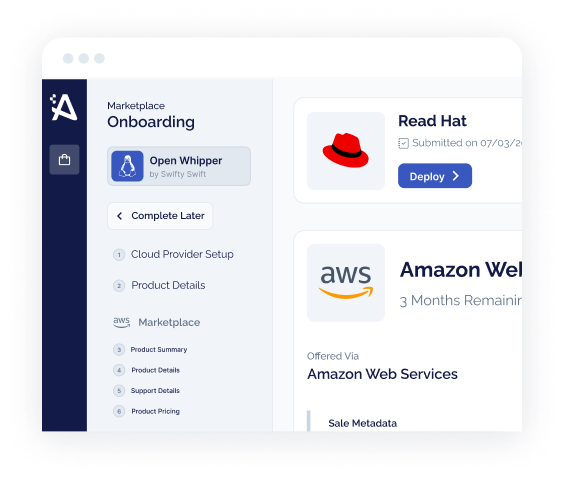

- Concurrent Agreements lets an AWS buyer hold more than one active agreement for the same product in a single AWS account. AWS Marketplace announced it on February 26, 2026 (AWS Marketplace What’s New).
- Since June 1, 2026, support is required for all new SaaS products, and every SaaS product created after that date has it enabled by default (AWS Marketplace, 2026).
- For SaaS it is an integration change, not a toggle: subscription notifications move from Amazon SNS to Amazon EventBridge, a new LicenseArn identifies each license, three core APIs are updated, and
CustomerIdentifiergives way toCustomerAWSAccountId(AWS Marketplace Seller Guide, 2026). - Professional Services listings were enabled automatically. Existing SaaS listings from before June 1, 2026 are not auto-enabled — sellers opt in.
For years, AWS Marketplace enforced a quiet ceiling that shaped how every expansion deal was structured: a buyer could hold only one active agreement per product per AWS account. On February 26, 2026, AWS removed that ceiling with Concurrent Agreements, and on June 1, 2026 it stopped being optional for new SaaS products (AWS Marketplace What’s New, 2026). If you sell SaaS on AWS Marketplace, this changed both how buyers can purchase from you and what your integration has to do under the hood — and the two are easy to conflate.
What Concurrent Agreements actually changed
Before this launch, one product could carry only one active agreement per buyer AWS account. Per AWS, that constraint forced sellers to build workarounds every time a customer wanted to expand mid-term, or when a second business unit inside the same account wanted its own negotiated terms (AWS Marketplace, February 2026). Concurrent Agreements removes the constraint outright: a buyer can now accept multiple offers for the same product without disrupting the agreements already in place.
- A second business unit could not buy independently under its own terms
- Mid-term expansions waited for the renewal cycle or forced a new account
- Repeat purchases meant amending the existing agreement, not adding one
- Sellers maintained workarounds to fake what the platform wouldn’t do
- Multiple business units procure independently, each with their own pricing
- Expansions transact immediately instead of waiting for renewal
- Repeat purchases are additive — new agreements sit alongside the old
- The workarounds go away, and so does the operational overhead of running them
AWS frames the benefit on both sides of the transaction: buyers get support for multi-team procurement within centralized AWS accounts, mid-term expansions, and repeat purchases; sellers can close multi-business-unit deals that were previously impossible and transact expansions on the spot (AWS Marketplace, February 2026).
The dates that bind
This is a phased change with one hard cutover. Reading the timeline correctly is the difference between “already handled” and “quietly non-compliant on your next new listing.”
AWS Marketplace announces Concurrent Agreements for SaaS and Professional Services, available in all AWS Regions where AWS Marketplace is supported (AWS Marketplace What’s New, 2026).
All Professional Services listings are enabled automatically, with no seller action required.
SaaS sellers who complete the integration work can opt in to enable Concurrent Agreements for their products ahead of the deadline.
Support becomes mandatory for all new SaaS products, and every SaaS product created after this date has Concurrent Agreements enabled by default (AWS Marketplace Seller Guide, 2026).
If you sell Professional Services listings, this was handled for you — nothing to do. If you sell SaaS, the requirement lands on your integration, and an existing SaaS listing created before June 1, 2026 is not switched on automatically. Sellers who want Concurrent Agreements on an older product have to opt in deliberately (AWS Marketplace, 2026).
What the SaaS integration change requires
The commercial headline — “buyers can hold multiple agreements” — rests on a technical change to how your service identifies and tracks entitlements. Per the AWS Marketplace Seller Guide, upgrading a SaaS product to Concurrent Agreements involves four moving parts.
Move notifications from SNS to EventBridge
Subscription and entitlement notifications shift from Amazon SNS to Amazon EventBridge, because SNS does not carry the new per-license identifier. Existing SNS integrations keep working, but new listings transition to EventBridge (AWS Marketplace user guide, 2026).
Adopt the new LicenseArn
Every new agreement grants a unique LicenseArn that identifies that specific license, so your system can tell two active agreements for the same product apart. For future-dated agreements, the LicenseArn is generated on the agreement start date — which can be months after the agreement ID exists (AWS Marketplace Seller Guide, 2026).
Update the three core APIs
The APIs you already use to resolve and verify customers now support LicenseArn: ResolveCustomer returns it alongside the customer identifiers, and your entitlement and metering calls carry it so usage attaches to the right license.
Retire CustomerIdentifier as your primary key
From June 1, 2026, new SaaS products should use CustomerAWSAccountId instead of CustomerIdentifier. Design your data schema with LicenseArn as the primary key from the start; for usage-only pricing, AWS provides the mapping through S3 buckets of CSV files linking CustomerIdentifier, CustomerAWSAccountId, AgreementId, and LicenseArn (AWS Marketplace Seller Guide, 2026).
The mistake that turns this into a painful migration is a schema that assumes one entitlement per customer account. If your database keys billing and access off CustomerIdentifier alone, two concurrent agreements collide. Re-key on LicenseArn before you enable the feature — retrofitting it after buyers hold multiple agreements is far harder than getting it right first. AWS publishes a hands-on integration lab for exactly this migration.
Why the commercial upside is bigger than it looks
It is tempting to file Concurrent Agreements under “plumbing” and move on. That underrates it. The old one-agreement ceiling was quietly capping your expansion revenue: the moment a happy customer wanted more — a second team, a mid-term seat bump, a new module — you either amended the single agreement or waited for renewal. Both add friction exactly when the buyer is ready to spend.
Concurrent Agreements doesn’t win you new logos. It stops the platform from throttling the expansions your existing customers already want to make.
That matters because expansion is where marketplace economics compound, and the buyer-side incentives point the same way. Enterprises hold enormous pre-committed cloud budgets — Omdia estimates more than $470B in cloud commitments across AWS, Azure, and GCP — and marketplace purchases draw that budget down. When a second business unit can procure independently under its own terms without disturbing the first, you have removed a structural blocker to capturing more of that commitment.
Forrester’s 2025 Total Economic Impact study of AWS Marketplace (commissioned by AWS) found buyers cut procurement time by 60% and solution-discovery time by 70% when purchasing through the marketplace. Concurrent Agreements extends that speed to the second, third, and fourth purchase — the ones that used to stall against a platform limit rather than a business objection.
What to do now: new sellers vs. existing sellers
Your next move depends entirely on where you are starting from.
If you are launching a new SaaS product, there is nothing to migrate — the requirements are built in, and Concurrent Agreements is on by default. The job is to build correctly from day one: EventBridge for notifications, LicenseArn as your primary key, and CustomerAWSAccountId for identity. Getting this right during your first integration is cheaper than any later fix, and it dovetails with the rest of a clean first listing — see our step-by-step guide to listing on AWS Marketplace and the guide to metering and usage-based pricing for the API mechanics.
If you have an existing SaaS listing from before June 1, 2026, it was not auto-enabled. Migration means updating your APIs and SDKs, redesigning your data schema around LicenseArn, and updating the customer experiences that assume a single agreement — then opting the product in. Sequence it: schema first, notifications second, opt-in last, so you are never live with buyers holding agreements your database can’t distinguish.
Consider a hypothetical composite to make the sequencing concrete — a 40-person security ISV with a mature AWS Marketplace SaaS listing whose billing keys entirely off CustomerIdentifier. The right order for them is to re-key on LicenseArn in a staging environment, migrate notifications to EventBridge, replay a test purchase to confirm two concurrent agreements resolve independently, and only then opt the production listing in. Rushing the opt-in before the schema work would mean a second agreement silently overwrites the first customer’s entitlement. (This example is illustrative, not a specific Automatum customer.)
- Confirm whether each listing is SaaS (your responsibility) or Professional Services (already enabled)
- Re-key entitlement and billing data on
LicenseArn, notCustomerIdentifieralone - Migrate subscription and entitlement notifications from Amazon SNS to Amazon EventBridge
- Update
ResolveCustomer, entitlement, and metering calls to carryLicenseArn - Switch identity to
CustomerAWSAccountIdfor any product created on or after June 1, 2026 - Test that two active agreements for the same product resolve and meter independently before opting in
- For older listings you want covered, opt in deliberately — it does not happen automatically
The integration is where Concurrent Agreements is won or lost.
Automatum runs the operational layer under AWS Marketplace — listing, pricing models, metering, entitlement, and disbursement — so changes like Concurrent Agreements land cleanly instead of breaking billing. See how it fits on the platform overview, or work through the marketplace listing checklist before you migrate.
See Automatum in Action →Frequently Asked Questions
Common questions about AWS Marketplace Concurrent Agreements for SaaS sellers.
What are AWS Marketplace Concurrent Agreements?
They let a buyer hold more than one active agreement for the same product within a single AWS account. AWS Marketplace announced the capability on February 26, 2026 for both SaaS and Professional Services products. Previously a buyer could keep only one active agreement per product per account, which blocked independent purchases by different business units, mid-term expansions, and repeat buys.
Is supporting Concurrent Agreements mandatory?
Yes, for new SaaS products. Since June 1, 2026, support is required for all new SaaS products, and every SaaS product created after that date has it enabled by default. Professional Services listings were enabled automatically with no seller action. Existing SaaS listings created before June 1, 2026 are not switched on automatically — sellers opt those in.
What technical changes does the SaaS integration require?
Four things, per the AWS Marketplace Seller Guide: move subscription and entitlement notifications from Amazon SNS to Amazon EventBridge; adopt the new LicenseArn that uniquely identifies each license; update the ResolveCustomer, entitlement, and metering APIs to carry LicenseArn; and use CustomerAWSAccountId instead of CustomerIdentifier for new products. Designing the data schema with LicenseArn as the primary key is the key step.
Do I have to migrate my existing AWS Marketplace SaaS listing?
Only if you want Concurrent Agreements on it. Existing listings keep working on their current integration and are not auto-enabled. To enable one, update the APIs and SDKs, redesign the data schema around LicenseArn, update customer experiences that assume a single agreement, then opt the product in. Sequence the schema change before the opt-in so a second agreement can never overwrite the first customer's entitlement.
Get the AWS Marketplace integration right
The listing, the metering model, and the management portal that Concurrent Agreements plugs into.