



AI Changes the Marketplace Pricing Conversation
AI products don't fit neatly into traditional SaaS marketplace pricing models. Usage patterns are unpredictable. Compute costs are variable. And the value delivered per API call varies wildly depending on the model, the prompt, and the use case.
Yet cloud marketplaces are becoming the primary distribution channel for enterprise AI software. The AI/ML categories on AWS, Azure, and GCP are the fastest-growing segments.
Four Pricing Models That Work for AI on Marketplace
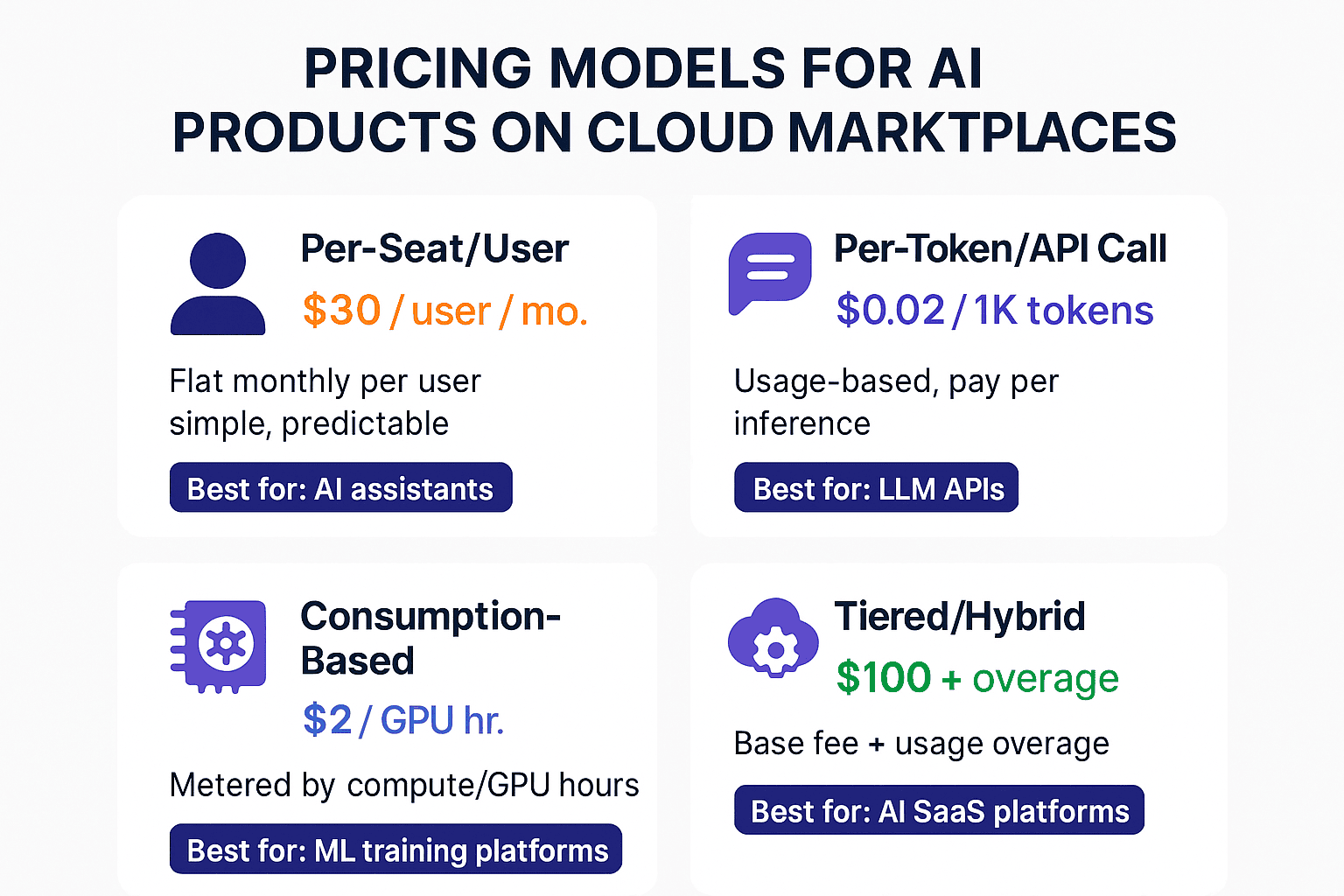
1. Per-Seat/User Pricing
Flat monthly per user. Simple and predictable. Best for: AI assistants, copilots, AI-powered SaaS tools where usage is relatively consistent per user. Marketplace implementation: SaaS Contract with user dimensions.
If you want a faster path through the analysis, the Marketplace Fee Calculator is free and takes under five minutes to model your net revenue across AWS, Azure, and GCP fee structures.
2. Per-Token/API Call Pricing
Pay per inference or API call. Aligns cost with actual consumption. Best for: LLM APIs, inference endpoints, embedding services. Marketplace implementation: Usage-based metering with API call dimensions.
3. Consumption-Based (Compute/GPU Hours)
Metered by compute resources consumed. Best for: ML training platforms, fine-tuning services, batch processing. Marketplace implementation: Hourly or monthly metering with compute dimensions.
4. Tiered/Hybrid Pricing
Base platform fee plus usage overage. Combines predictability with usage alignment. Best for: AI SaaS platforms with both base functionality and variable AI features. Marketplace implementation: SaaS Contract with consumption component.
The AI Listing Categories
- AWS: AI/ML category with sections for foundation models, SageMaker products, and AI agents
- Azure: AI Apps & Agents (standalone first-tier category since late 2025)
- GCP: AI/ML with strong Vertex AI and Gemini integration emphasis
Special Considerations for AI Listings
- GPU cost pass-through: If your product uses customer-provisioned GPUs, pricing needs to account for the variable infrastructure cost
- Model versioning: As you update models, existing customers on marketplace subscriptions need migration paths
- Data residency: Enterprise AI buyers increasingly require data processing in specific regions
- SLA for inference latency: Enterprise customers expect SLA guarantees that should be reflected in your listing terms
Why Marketplace Matters More for AI
Enterprise procurement teams are especially cautious about AI vendors. Marketplace listing provides inherited trust from the cloud provider, committed spend eligibility that reduces budget friction, and a procurement path that doesn't require new vendor onboarding.
Automatum simplifies cloud marketplace operations across AWS, Azure, and GCP.
Book a Working Session →Frequently Asked Questions
Common questions about the topics covered in this guide.
What pricing model works best for AI products on marketplace?
Per-token or consumption-based pricing aligns with how AI products deliver value. However, many enterprise buyers prefer hybrid models with a base subscription plus usage overage for budget predictability.
Can I list AI models on cloud marketplaces?
Yes. AWS offers Bedrock and SageMaker JumpStart, Azure has the Model Catalog, and GCP has Vertex AI Model Garden. Each marketplace has dedicated AI and ML categories with growing buyer traffic.
How do AI companies handle metering on marketplace?
AI products typically meter on API calls, tokens processed, inference hours, or data volume. The cloud provider's metering APIs support custom dimensions, so you can define exactly what gets measured and billed.
Should AI startups list on cloud marketplace?
Yes. Cloud marketplaces provide access to enterprise buyers with committed spend and streamlined procurement. For AI startups, this eliminates the long enterprise sales cycle that often delays revenue.
Keep building your marketplace motion
More guides for AI companies entering cloud marketplaces.