



Why Free Trials Are the Growth Engine of Cloud Marketplaces
Free trials have become one of the most powerful levers for driving adoption and revenue on cloud marketplaces. According to industry data, SaaS products that offer a free trial on cloud marketplaces see conversion rates between 15% and 30%, compared to the 2% to 5% typical of direct website trials.
The reason is straightforward: marketplace buyers have already committed budgets, procurement processes are streamlined, and the trust barrier established by AWS, Azure, or GCP dramatically reduces purchase friction.
For ISVs, the cloud marketplace trial is not just a product demo mechanism. It is a qualified pipeline generator.
Buyers who activate a trial through a marketplace have already navigated procurement approval, which means they are further along the purchasing journey than a typical website visitor. This makes every trial activation significantly more valuable, and every lost conversion significantly more costly.
The stakes are high because marketplace algorithms and featured placement rankings often factor in conversion rates and customer engagement metrics. A poorly structured trial that generates churn or low engagement can actually harm your marketplace visibility, creating a negative feedback loop that suppresses future discovery.
Getting your trial strategy right is therefore not optional; it is foundational to your marketplace growth trajectory.
Types of Free Trials on Cloud Marketplaces
Not all free trials are created equal. The type of trial you offer should align with your product's complexity, your target buyer persona, and the marketplace's native capabilities.
If you want a faster path through the analysis, the Marketplace ROI Calculator is free and takes under five minutes to project your marketplace revenue and payback timeline.
Each trial model carries distinct implications for conversion optimization, metering infrastructure, and customer onboarding.
Time-Limited Trials
Time-limited trials grant full access to your product for a fixed period, typically 7, 14, or 30 days. This is the most common trial model on cloud marketplaces because it is simple to implement and easy for buyers to understand.
The urgency created by a countdown timer drives action, but it also means you must deliver value quickly. If your product requires significant configuration or data migration, a 7-day trial may not give buyers enough time to reach their "aha moment," leading to poor conversion rates.
Feature-Limited Trials (Freemium on Marketplace)
Feature-limited trials provide indefinite access to a restricted version of your product. Buyers can use core features without time pressure, and conversion happens when they need premium capabilities.
This model works well for products with clear feature tiers, such as basic analytics versus advanced reporting, or single-user versus team collaboration. The challenge is designing the feature boundary so that it delivers enough value to demonstrate the product while creating genuine need for the paid tier.
Usage-Limited Trials
Usage-limited trials allow full feature access but cap consumption at a specific threshold, such as 1,000 API calls, 10 GB of data processed, or 50 reports generated. This model is particularly effective for metered and consumption-based products because it directly ties the trial experience to the pricing model buyers will encounter after conversion.
It also provides rich usage data that your sales team can use during the conversion conversation.
How Each Marketplace Handles Trials Differently
Understanding the native trial capabilities and constraints of each cloud marketplace is essential for designing an effective trial strategy. Each platform has distinct mechanics for trial activation, billing transitions, and customer communication that directly impact your conversion approach.
| Feature | AWS Marketplace | Azure Marketplace | GCP Marketplace |
|---|---|---|---|
| Trial Duration Options | Custom (typically 7-30 days) | 1 month standard, custom available | Custom (typically 14-30 days) |
| Billing Transition | Automatic conversion to paid plan at trial end | Automatic or manual conversion based on offer type | Automatic conversion with notification |
| Trial Pricing Support | $0 contract with auto-upgrade or separate trial SKU | Free trial flag in offer configuration | Free trial pricing plan with expiry |
| Customer Notification | AWS sends billing notification before conversion | Azure sends email reminders | GCP sends notification 3 days before trial ends |
| Cancellation During Trial | Buyer can cancel anytime via AWS console | Buyer can cancel via Azure portal | Buyer can cancel via GCP console |
| Usage Metering During Trial | Supported via Metering API (report $0 or actual usage) | Supported via Metered Billing API | Supported via Procurement API |
| Private Offer Trials | Supported with custom trial periods | Supported via private plans | Supported with custom pricing |
The key difference to note is billing transition behavior. On AWS Marketplace, trials configured as $0 contracts with auto-upgrade will automatically begin billing the buyer at the contracted rate when the trial period ends, unless the buyer explicitly cancels.
Azure provides more flexibility with both automatic and manual conversion paths, depending on how you structure your SaaS offer. GCP's approach is similar to AWS, with automatic conversion and pre-expiry notifications.
These differences mean your trial communication cadence, onboarding urgency, and conversion touchpoints must be calibrated per marketplace. A one-size-fits-all trial playbook will leave conversion on the table.
Conversion Optimization Strategies
Converting trial users into paying customers on cloud marketplaces requires a deliberate, multi-stage approach. The window between trial activation and billing commencement is your highest-use period, and every day within it should be orchestrated to move the buyer closer to recognizing the product's value.
Map the Time-to-Value Journey
Before anything else, identify the specific moment when a trial user first experiences meaningful value from your product. This "aha moment" might be generating their first report, processing their first batch of data, or seeing their first automated workflow complete.
Your entire trial experience should be engineered to reach this moment as quickly as possible, ideally within the first 48 hours. Research from Totango and other SaaS analytics platforms consistently shows that users who reach the aha moment within the first two days of a trial convert at 3x to 5x the rate of those who do not.
Implement Progressive Onboarding
Avoid overwhelming trial users with every feature on day one. Instead, design a progressive onboarding flow that introduces capabilities in a logical sequence aligned with the user's workflow. Day one should focus on core setup and initial value delivery.
Days two through five should introduce integrations and advanced features. The final phase of the trial should showcase the full platform capability and make the case for ongoing usage.
Each stage should include contextual guidance, whether through in-app tooltips, guided walkthroughs, or targeted emails.
Use Usage Data for Personalized Outreach
Cloud marketplace trials generate valuable usage telemetry. Track which features trial users engage with, how frequently they log in, and where they drop off. Use this data to segment trial users into engagement tiers and tailor your conversion outreach accordingly.
High-engagement users can receive a direct sales touch with a custom pricing proposal. Medium-engagement users might benefit from a guided demo of features they have not yet explored. Low-engagement users may need a re-activation campaign or a check-in call to diagnose blockers.
Create Urgency Without Pressure
Effective trial conversion balances urgency with helpfulness. Send reminder communications at the 50%, 75%, and 90% marks of the trial period, but frame each communication around value rather than deadlines.
Instead of "Your trial expires in 3 days," try "You have processed 2,400 records this week.
Here is what changes when your trial transitions to a paid plan." This approach respects the buyer's intelligence and reinforces the value they have already received.
Pricing Psychology for Trial-to-Paid Conversion
The pricing structure you present during the trial-to-paid transition has an outsized impact on conversion rates. Buyers who have been using your product for free are psychologically anchored to a $0 price point, and the transition to paid must be managed carefully to avoid sticker shock and abandonment.
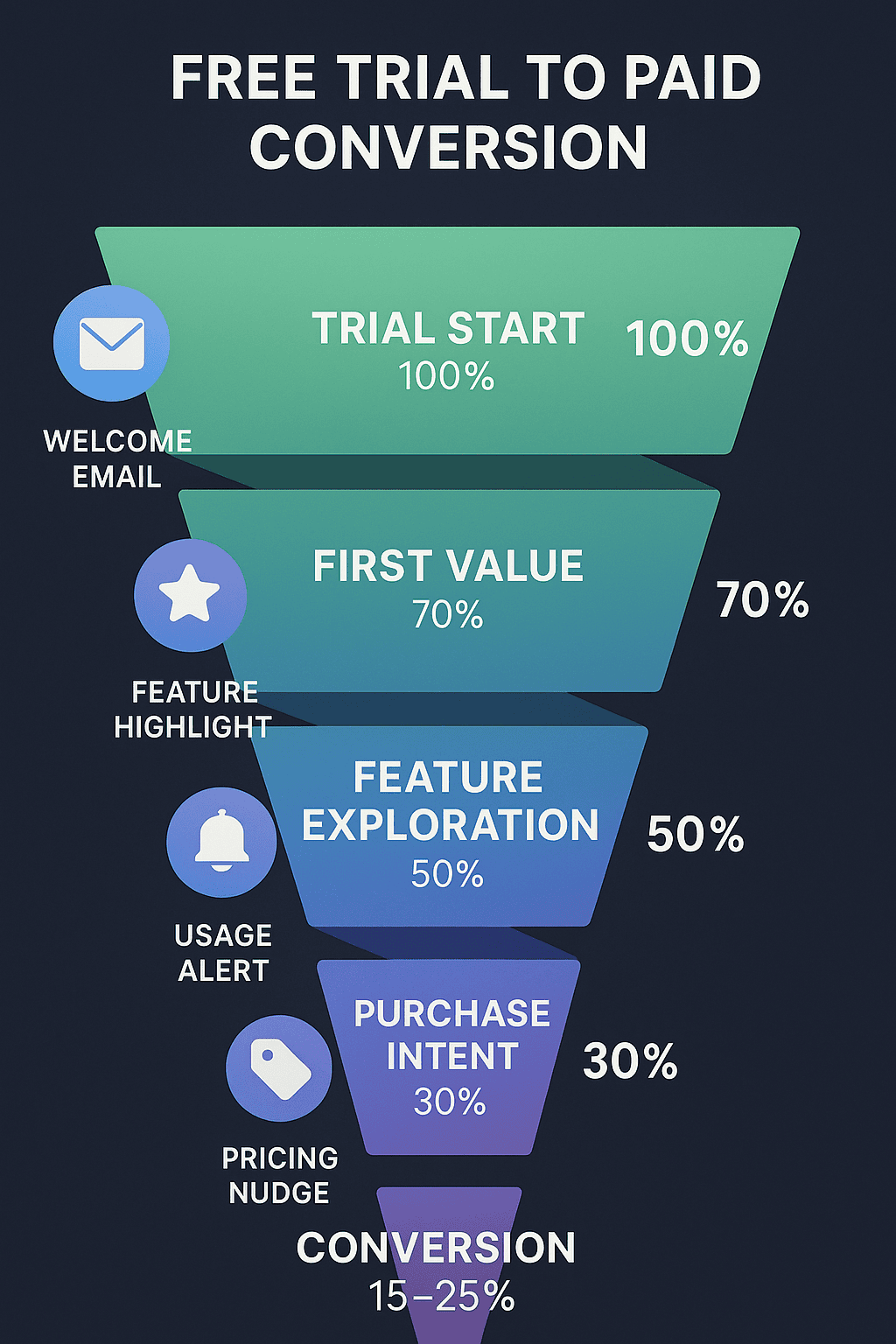
One proven approach is to offer a discounted first month or quarter after the trial. This "bridge pricing" reduces the perceived jump from free to paid and gives buyers additional time to build internal advocacy for the purchase.
On AWS Marketplace, you can structure this as a private offer with a reduced initial period followed by standard pricing. Azure supports similar flexibility through custom private plans.
Tiered pricing is another powerful tool for trial conversion. Instead of presenting a single paid option, offer two or three tiers that correspond to different levels of usage or capability.
Trial users who are not ready for your top tier can convert to a lower tier, preserving the customer relationship and creating an expansion path for the future. Data from OpenView Partners indicates that SaaS companies using tiered pricing on marketplaces see 20% to 35% higher trial conversion rates compared to single-tier offerings.
Consumption-based pricing aligns particularly well with trial conversion because the buyer pays proportionally to the value they receive. If your product supports metered billing on the marketplace, the transition from free trial to paid usage can be nearly smooth, with the buyer simply continuing to use the product and paying for what they consume.
Onboarding Best Practices During the Trial Period
The onboarding experience during a marketplace trial is arguably more important than the onboarding for a direct sale. Marketplace buyers have procurement-level expectations around ease of deployment, security compliance, and time to value.
They are accustomed to the cloud's promise of instant provisioning and will not tolerate multi-day setup processes or manual configuration hurdles.
Automate Provisioning Completely
When a buyer activates your trial on a cloud marketplace, the account provisioning and initial configuration should happen within seconds, not hours. Use the marketplace's SaaS fulfillment APIs to automatically create the buyer's account, assign appropriate permissions, and pre-configure default settings.
Any manual step in this process is a conversion leak. ISVs that achieve fully automated provisioning report trial activation rates 40% to 60% higher than those requiring manual setup.
Provide Contextual Documentation
Do not point trial users to a generic documentation site and expect them to find what they need. Instead, deliver contextual help that is specific to their current onboarding stage.
If they just activated the trial, show them a quick-start guide tailored to their cloud environment.
If they are configuring integrations, surface relevant API documentation and code samples. Contextual documentation reduces support ticket volume during trials by an estimated 30% to 50%, freeing your team to focus on high-value conversion activities.
Assign a Success Contact Early
For enterprise-tier trials, assign a customer success manager or solutions engineer within the first 24 hours. This human touchpoint serves multiple purposes: it demonstrates investment in the buyer's success, provides a direct channel for resolving blockers, and creates a relationship that facilitates the conversion conversation.
Even for self-serve trials, a brief introductory email from a named contact significantly outperforms generic automated sequences.
Metering and Usage Tracking During Trials
Accurate metering during the trial period serves dual purposes. First, it provides the usage data you need to inform conversion conversations and segment trial users by engagement.
Second, it validates your metering infrastructure before the buyer transitions to paid billing, ensuring that the first invoice is accurate and trustworthy.
On AWS Marketplace, use the AWS Marketplace Metering Service to report usage dimensions during the trial, even if you are billing $0. This establishes the metering pipeline and allows you to demonstrate to the buyer exactly what their post-trial costs will look like based on actual usage.
Azure's Metered Billing APIs support the same pattern, enabling you to track consumption during free periods and project future costs.
Build a usage dashboard that is visible to the trial user. Transparency about consumption builds trust and eliminates billing surprises at conversion.
Show the buyer how much they have used, what it would have cost on a paid plan, and how their usage trends over time. This dashboard becomes a powerful conversion tool because it quantifies value in terms the buyer (and their procurement team) can understand.
Automating the Trial-to-Paid Transition
Manual trial-to-paid transitions are a leading cause of both lost conversions and billing disputes. When a human must intervene to change a subscription status, errors are inevitable: trials extend beyond their intended period, billing starts before the buyer expects it, or conversion falls through the cracks entirely.
Automation eliminates these risks and ensures a consistent, professional experience for every trial user.
Design your trial system around three automated triggers. The first trigger fires at trial activation, initiating the onboarding sequence and starting the countdown timer.
The second trigger fires at a configurable warning threshold (for example, 3 days before expiry), sending the buyer a summary of their trial usage and a clear explanation of what happens next. The third trigger fires at trial expiry, either converting the subscription to paid or gracefully deactivating access depending on whether the buyer has opted in.
For marketplaces that support auto-conversion (AWS and GCP), ensure your system handles the billing transition gracefully on the backend. The buyer should see no disruption in service, and the first metered usage report after conversion should be accurate to the minute.
For Azure, where manual conversion paths are available, your automation should create a private plan or offer and deliver it to the buyer before the trial expires, minimizing the gap between trial end and paid activation.
Measuring Trial Success: Key Metrics
You cannot optimize what you do not measure. Establishing a rigorous metrics framework for your marketplace trials enables data-driven iteration and reveals exactly where your conversion funnel leaks.
- Trial Activation Rate: The percentage of marketplace visitors who start a trial. Benchmark: 8% to 15% for well-optimized listings. If yours is below 5%, your listing copy, screenshots, or pricing presentation need attention.
- Time to First Value (TTFV): The elapsed time between trial activation and the user's first meaningful action. Target: under 24 hours. If TTFV exceeds 48 hours, your onboarding flow has friction that must be identified and removed.
- Trial Engagement Score: A composite metric based on login frequency, feature adoption breadth, and usage volume during the trial. Segment users into high, medium, and low engagement cohorts and track conversion rates for each.
- Trial-to-Paid Conversion Rate: The percentage of trial users who convert to a paid subscription. Benchmark: 15% to 30% on cloud marketplaces. Best-in-class ISVs achieve 35% or higher through optimized onboarding and proactive conversion tactics.
- Time to Conversion: The number of days between trial activation and paid conversion. Shorter is generally better, but premature conversion pressure can backfire. Aim for conversion within the first 60% of the trial period.
- Post-Trial Churn Rate: The percentage of converted trial users who cancel within 90 days. If post-trial churn exceeds 20%, the trial experience is not adequately preparing buyers for the paid product, or the paid product is not delivering on the trial's promise.
Common Trial Mistakes to Avoid
Even experienced ISVs make avoidable mistakes when structuring marketplace trials. Recognizing these patterns can save you months of suboptimal performance and lost revenue.
Offering Trials That Are Too Long
A 30-day trial sounds generous, but it often backfires. Long trials reduce urgency, encourage procrastination, and give buyers time to forget about your product entirely.
Data from multiple SaaS benchmarking studies shows that 14-day trials consistently outperform 30-day trials on conversion rate. The exception is complex enterprise software that genuinely requires extended evaluation periods, but even then, consider a structured 14-day guided trial with an extension available on request rather than a blanket 30-day window.
Neglecting the Post-Activation Experience
Many ISVs invest heavily in marketplace listing optimization to drive trial activations but then go silent after the buyer starts the trial. The post-activation period is where conversion is won or lost.
Every trial user should receive a structured communication sequence that includes a welcome message, onboarding milestones, usage insights, and conversion-oriented touchpoints. Silence during the trial is the equivalent of abandoning a qualified lead.
Failing to Differentiate the Trial from the Paid Product
If the trial experience is identical to the paid product with no visible distinction, buyers have no reason to convert. They will use the trial, extract what they need, and move on.
Ensure that trial users understand exactly what additional value the paid product provides, whether that is higher usage limits, premium support, additional integrations, or advanced features. The transition from trial to paid should feel like an upgrade, not a surprise invoice.
Ignoring Marketplace-Specific Billing Mechanics
Each marketplace has unique billing transition behaviors, and ISVs who do not account for these differences create confusing experiences for buyers. On AWS, auto-converting trials that charge a full monthly subscription on day one after the trial can create sticker shock if the buyer expected prorated billing.
On Azure, failing to configure the trial-to-paid transition correctly can result in a billing gap where the buyer loses access. Test your trial-to-paid flow on each marketplace thoroughly before launching.
Streamline Your Trial Strategy with Automatum
Managing free trials across multiple cloud marketplaces is operationally complex. Each marketplace has its own APIs, billing mechanics, and trial configuration requirements, and keeping them synchronized manually is a recipe for errors, missed conversions, and billing disputes.
Automatum simplifies the entire trial lifecycle for ISVs selling on AWS, Azure, and GCP marketplaces. From automated provisioning and metering during the trial period to smooth billing transitions and conversion analytics, Automatum provides a unified platform that eliminates the operational overhead of multi-marketplace trial management.
With built-in usage tracking, private offer automation, and real-time analytics, your team can focus on what matters most: helping trial users discover value and converting them into long-term customers.
Whether you are launching your first marketplace trial or optimizing an existing trial program across multiple clouds, Automatum gives you the tools and visibility to maximize conversion rates and accelerate revenue growth. Visit automatum.io to learn how leading ISVs are transforming their marketplace trial strategies.
Automatum simplifies cloud marketplace operations across AWS, Azure, and GCP.
Book a Working Session →Frequently Asked Questions
Common questions about the topics covered in this guide.
What is a good trial-to-paid conversion rate on marketplace?
Industry benchmarks for cloud marketplace trials range from 15 to 30 percent. Time-limited trials with strong onboarding sequences typically convert at the higher end. Feature-limited trials convert lower but attract more sign-ups.
What trial types do cloud marketplaces support?
AWS supports time-limited free trials on SaaS contracts and usage-limited trials. Azure supports free trials through private plans. GCP supports trial periods configured through the Procurement API. Each has different setup requirements.
How do I optimize marketplace trial onboarding?
Send a welcome sequence within the first hour. Provide a quick-start guide focused on time-to-value. Schedule a human touchpoint within 48 hours for enterprise trials. Track product usage to identify engaged versus dormant trial users.
Should I offer a free tier or a free trial on marketplace?
Free trials create urgency through time limits and convert better for enterprise products. Free tiers work for developer-focused tools where broad adoption leads to enterprise expansion. Most B2B SaaS should use time-limited trials.
Keep building your marketplace motion
Guides for optimizing your marketplace go-to-market motion.