




What Is Cloud Marketplace Procurement?
Cloud marketplace procurement is the process of purchasing third-party software directly through a cloud provider's marketplace, such as AWS Marketplace, Azure Marketplace, or Google Cloud Marketplace. Instead of navigating traditional vendor procurement cycles that involve separate contracts, billing relationships, and security reviews, enterprises can discover, evaluate, and purchase software through the same cloud platform they already use for infrastructure.
The transaction is processed through the cloud provider, which means the purchase draws down from existing cloud committed spend and appears on a single consolidated invoice.
This model has grown rapidly since 2022, with Canalys reporting that cloud marketplace transactions exceeded $16 billion globally in 2025, up from roughly $4 billion in 2022. The acceleration is driven by enterprises sitting on large pools of committed cloud spend, often negotiated through Enterprise Discount Programs (EDPs) on AWS, Microsoft Azure Consumption Commitments (MACCs), or Google Cloud Committed Use Discounts (CUDs).
Procurement teams increasingly view marketplace purchases as a strategic lever to maximize the value of these commitments rather than letting unused credits expire.
For ISVs (Independent Software Vendors), understanding how enterprise procurement teams think about marketplace buying is critical. When you optimize your listing, pricing, and private offer workflows for how procurement actually works, you reduce friction, shorten sales cycles, and tap into budgets that would otherwise be inaccessible through traditional channels.
This guide walks through the entire procurement journey from both the buyer and seller perspective.
Why Enterprises Buy Through Cloud Marketplaces
Committed Spend Drawdown
The single most powerful driver of marketplace adoption is committed spend. Enterprises negotiate multi-year cloud agreements worth millions of dollars, and a significant portion of this spend often goes underutilized.
If you want a faster path through the analysis, the Marketplace Readiness Assessment is free and takes under five minutes to assess your readiness before investing in listing work.
According to Flexera's 2025 State of the Cloud report, organizations waste an average of 28% of their cloud spend.
Marketplace purchases count toward these commitments, which means procurement teams can deploy budget that would otherwise expire. For a company with a $50 million annual Azure MACC, purchasing $2 million of third-party software through Azure Marketplace effectively costs them nothing incremental because it draws from money already committed.
Simplified Vendor Onboarding
Traditional enterprise procurement requires vendors to go through extensive onboarding processes: registering in vendor management systems, completing security questionnaires, providing proof of insurance, negotiating payment terms, and setting up invoicing. This process typically takes 30 to 90 days and involves legal, security, finance, and IT teams.
When purchasing through a cloud marketplace, the cloud provider has already vetted the vendor and handles billing, payment, and basic compliance. The buyer's existing cloud agreement covers the contractual framework, reducing vendor onboarding from months to days in many cases.
Consolidated Billing and Cost Visibility
Enterprise finance teams spend significant effort reconciling invoices from hundreds of SaaS vendors. Cloud marketplace purchases appear on the same invoice as infrastructure costs, providing a single pane of glass for all cloud-related spending.
This simplification is especially valuable for organizations implementing FinOps practices, where detailed visibility into cloud costs is essential for optimization. Marketplace purchases are automatically tagged and categorized within cloud cost management tools like AWS Cost Explorer or Azure Cost Management, making it easier to allocate costs to business units and track ROI.
Pre-Negotiated Compliance and Security
Cloud providers maintain rigorous standards for marketplace listings. AWS, Azure, and GCP all require sellers to meet baseline security requirements, and many listings carry additional certifications such as SOC 2, ISO 27001, or FedRAMP authorization.
For enterprise procurement teams, this pre-vetting reduces the burden of independent security assessments. While organizations still perform their own due diligence, the marketplace listing itself serves as a trust signal that accelerates the evaluation process.
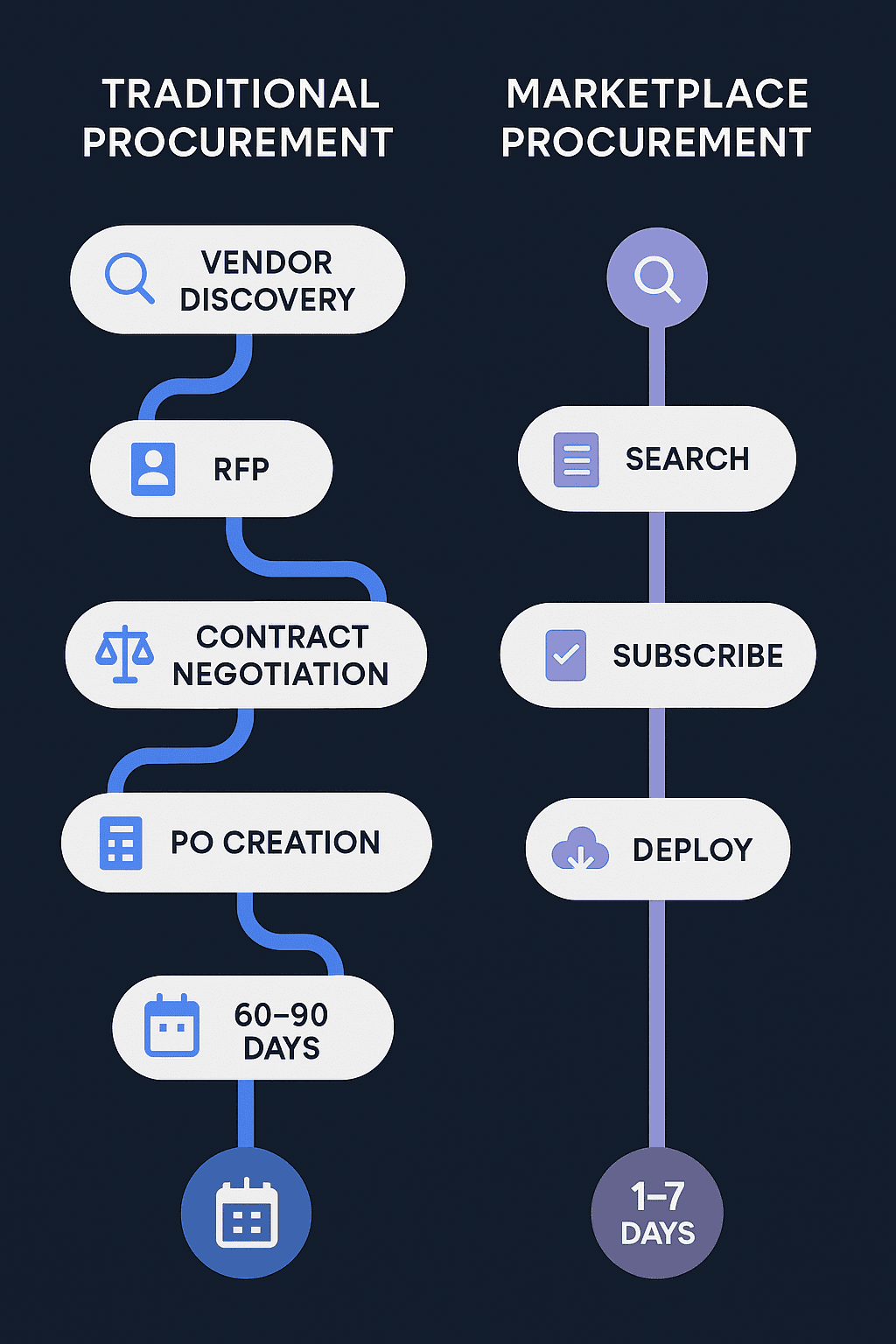
Traditional Procurement vs. Marketplace Procurement
The differences between traditional software procurement and marketplace procurement are substantial across nearly every dimension. Understanding these differences helps both buyers and sellers set appropriate expectations and optimize their processes accordingly.
The following comparison highlights the key contrasts that drive enterprises toward marketplace channels.
| Dimension | Traditional Procurement | Marketplace Procurement |
|---|---|---|
| Average time to close | 60-120 days | 14-30 days |
| Contracts required | MSA + SOW + DPA + NDA (4+ documents) | Cloud provider EULA or custom EULA (1-2 documents) |
| Billing setup | PO creation, invoice processing, net-30/60 payment | Automatic via existing cloud invoice |
| Vendor onboarding | Security review, vendor registration, insurance verification | Pre-vetted by cloud provider |
| Budget source | Dedicated software budget line item | Cloud committed spend (often pre-allocated) |
| Approval workflow | IT, Security, Legal, Finance, Procurement (5+ teams) | Cloud team + Finance approval (2-3 teams) |
| Renewal process | Full re-negotiation cycle | Auto-renewal or streamlined re-subscription |
| Compliance documentation | Vendor-provided, manually verified | Marketplace-certified, continuously monitored |
| Cost attribution | Manual invoice reconciliation | Automatic cost tagging and allocation |
The Marketplace Procurement Workflow Step by Step
Step 1: Discovery and Evaluation
The procurement journey begins when a technical team or business unit identifies a need. On cloud marketplaces, discovery happens through the marketplace search interface, curated collections, or increasingly through cloud provider sales teams who recommend ISV solutions as part of co-sell motions.
Buyers can review product descriptions, pricing, customer reviews, and compliance certifications directly on the listing page.
Many marketplaces also offer free trials or sandbox environments that let technical evaluators test the product before involving procurement. ISVs should ensure their listings include comprehensive technical documentation, clear pricing, and prominent compliance badges to facilitate this evaluation phase.
Step 2: Internal Stakeholder Alignment
Once a technical team identifies a preferred solution, they need to align internal stakeholders. In marketplace procurement, this alignment is typically faster because the budget conversation shifts from requesting new software budget to utilizing existing cloud committed spend.
The technical evaluator presents the solution to their manager, who routes it to the cloud platform team and finance.
Since the purchase will count against existing cloud commitments, finance teams are often more receptive than they would be for a net-new budget request. ISVs can support this step by providing ROI calculators, cost comparison sheets, and clear documentation on how the purchase applies to committed spend.
Step 3: Private Offer Negotiation
For enterprise deals, marketplace purchases typically go through a private offer workflow rather than public listing prices. A private offer allows the ISV to create a custom pricing proposal for a specific buyer, including negotiated discounts, custom payment schedules (monthly, annual, or multi-year), and tailored terms.
The buyer's procurement team reviews the private offer alongside any custom EULA terms.
On AWS Marketplace, private offers can include flexible payment schedules and custom contract durations. Azure Marketplace supports similar functionality through its private offer system.
This negotiation phase usually takes one to two weeks, compared to four to eight weeks for traditional contract negotiations.
Step 4: Approval and Purchase
With the private offer in place, the buyer's procurement team routes it through their approval workflow. Because the purchase draws from existing cloud committed spend, the approval chain is typically shorter.
The cloud platform team confirms the purchase counts toward their committed spend agreement, finance approves the drawdown, and the purchasing agent accepts the private offer through the marketplace console.
The entire approval process can happen within days rather than the weeks required for traditional procurement. Once accepted, the subscription begins immediately and the ISV is notified to provision the buyer's account.
Step 5: Post-Purchase Management
After purchase, the subscription is managed through the marketplace. Usage is tracked automatically, invoicing is handled by the cloud provider, and renewals can be configured for auto-renewal or manual renewal.
Procurement teams can monitor spending through their cloud cost management tools, and the ISV can track customer usage through marketplace reporting APIs.
For ISVs, this post-purchase phase is critical for retention. Providing excellent onboarding, proactive support, and regular usage reports builds the foundation for renewal and expansion conversations.
How ISVs Can Optimize for Enterprise Buyers
Make Your Listing Procurement-Friendly
Enterprise procurement teams evaluate dozens of vendors simultaneously, so your marketplace listing needs to stand out while also removing friction. Start with a clear, jargon-free product description that explains what your software does, who it serves, and what business outcomes it delivers.
Include specific use cases and industry verticals rather than generic capability statements.
List all compliance certifications prominently because procurement teams filter on these. Ensure your pricing is transparent and includes at least one public pricing tier alongside the option to request a private offer for custom pricing.
Listings with unclear or hidden pricing create friction that causes procurement teams to move on to alternatives.
Streamline Your Private Offer Process
Private offers are the primary vehicle for enterprise marketplace deals, so your ability to create, send, and manage them efficiently directly impacts deal velocity. Establish internal SLAs for private offer creation, aiming for same-day turnaround on standard requests and 48-hour turnaround on custom terms.
Pre-approve common discount ranges so your sales team can generate offers without waiting for management approval on every deal. Use a platform like Automatum to automate private offer creation across AWS, Azure, and GCP marketplaces from a single interface, eliminating the need to manually navigate each marketplace's seller console.
Align with Cloud Provider Co-Sell Programs
Cloud providers actively incentivize their sales teams to recommend marketplace solutions because it drives cloud consumption and platform stickiness. AWS ISV Accelerate, Microsoft Azure IP Co-Sell, and Google Cloud Partner Advantage all provide mechanisms for ISVs to co-sell alongside cloud provider reps.
When a cloud provider's sales team recommends your solution, procurement teams view it as pre-vetted and trustworthy, dramatically reducing the evaluation cycle. Invest in building co-sell relationships by registering opportunities, sharing customer success stories, and maintaining up-to-date solution briefs that cloud seller teams can reference during customer conversations.
Private Offers from the Buyer's Perspective
Enterprise buyers have specific expectations when they receive a private offer through a cloud marketplace. Understanding these expectations helps ISVs structure offers that close faster.
Buyers expect the private offer to include all commercial terms in a single document rather than requiring separate agreements.
They expect the pricing to reflect a meaningful discount compared to public list prices, typically 10% to 30% depending on deal size and contract duration. Multi-year offers should include built-in annual price protections, and payment schedules should align with the buyer's fiscal calendar.
Buyers also expect flexibility in how the offer is structured. Some enterprises prefer annual upfront payments for maximum committed spend drawdown, while others need monthly billing for budget predictability.
Some need the ability to scale usage up or down during the contract term.
ISVs who can accommodate these preferences through flexible private offer configurations win more deals. On the compliance side, buyers expect the private offer to reference the cloud provider's standard EULA or a pre-negotiated custom EULA.
Any additional terms should be clearly documented as amendments rather than requiring a separate legal review process.
Finally, buyers expect a responsive experience after accepting the offer. Account provisioning should be immediate or near-immediate, with a dedicated onboarding contact available within 24 hours.
Delays between offer acceptance and account access erode trust and create negative impressions that affect renewal conversations. ISVs should automate their provisioning workflows to ensure smooth post-purchase experiences.
Common Procurement Objections and How to Overcome Them
We Already Have a Direct Relationship with This Vendor
Procurement teams sometimes resist marketplace purchases when they have existing direct contracts with the ISV. The response should focus on financial advantages: marketplace purchases count against committed cloud spend, which means the software is effectively pre-budgeted.
Additionally, consolidated billing through the marketplace reduces administrative overhead.
Position the marketplace channel as a financial optimization rather than a replacement of the existing relationship. The vendor relationship remains the same; only the billing mechanism changes.
The Cloud Provider Takes a Fee
Some finance teams raise concerns about the marketplace fee (typically 3% to 5% of the transaction value) that cloud providers charge sellers. From the buyer's perspective, this fee is irrelevant because it is paid by the seller, not the buyer.
However, if the concern is that the fee inflates pricing, ISVs should be prepared to demonstrate that their marketplace pricing is competitive with or identical to direct pricing. Many ISVs absorb the marketplace fee as a cost of sales, recognizing that faster deal cycles and access to committed spend budgets more than offset the fee.
We Need Custom Contract Terms
Enterprise legal teams often require custom terms beyond the standard marketplace EULA. All major cloud marketplaces now support custom EULAs attached to private offers.
ISVs should maintain a library of pre-approved custom EULA templates that address common enterprise requirements such as data processing agreements, SLA commitments, indemnification clauses, and liability caps.
Having these templates ready eliminates the back-and-forth legal negotiation that delays deal closure. For particularly complex requirements, ISVs can use the marketplace's custom contract upload feature to attach a fully negotiated agreement to the private offer.
We Cannot Verify the Vendor's Security Posture
Security teams may question whether marketplace listing is sufficient evidence of a vendor's security posture. While marketplace listing does require baseline security, ISVs should proactively provide comprehensive security documentation including SOC 2 Type II reports, penetration test summaries, architecture diagrams, and data flow documentation.
Making this information available through the marketplace listing or a readily accessible security page reduces back-and-forth and demonstrates transparency. For regulated industries, including relevant compliance certifications such as HIPAA, PCI DSS, or FedRAMP authorization directly in the listing provides immediate assurance.
Tips for Making Your Listings Procurement-Friendly
- Use clear, benefit-driven product descriptions that explain business outcomes rather than listing technical features. Procurement teams are not engineers and need to understand value quickly.
- Display pricing transparently with at least one public pricing tier. Hide-the-price strategies that work in direct sales create friction in marketplace procurement.
- List all compliance certifications prominently on your listing. SOC 2, ISO 27001, HIPAA, FedRAMP, and GDPR badges are table stakes for enterprise buyers.
- Offer free trials or sandbox access so technical evaluators can validate the product before engaging procurement. Marketplace free trials reduce perceived risk.
- Maintain multiple pricing tiers that map to different buyer segments. Startups, mid-market, and enterprise buyers have different needs and budgets.
- Provide comprehensive documentation links directly in your listing. API references, integration guides, and architecture overviews help technical evaluators build internal business cases.
- Respond to private offer requests within 24 hours. Marketplace deals move fast, and slow responses cause buyers to evaluate alternatives.
- Support multi-year contracts with flexible payment schedules. Enterprise procurement teams plan in annual and multi-year cycles, and flexibility here wins deals.
- Include customer logos and case studies in your listing where possible. Social proof accelerates procurement decisions, especially when the references are in the buyer's industry.
- Keep your listing updated with the latest product capabilities, pricing changes, and compliance certifications. Stale listings signal an inactive or disengaged vendor.
The Future of Marketplace Procurement
Cloud marketplace procurement is evolving rapidly. Several trends will shape the landscape through 2026 and beyond. First, multi-cloud procurement is becoming standard as enterprises maintain commitments across two or more cloud providers.
Buyers increasingly expect ISVs to be listed on all three major marketplaces, with consistent pricing and capabilities across each. ISVs who only list on a single marketplace miss procurement opportunities when the buyer's committed spend is concentrated on a different cloud.
Second, marketplace-native procurement tools are maturing. AWS Marketplace now offers Procurement System Integration (PSI) that connects directly with enterprise procurement platforms like Coupa, SAP Ariba, and ServiceNow.
Azure Marketplace integrates with Microsoft's own procurement tools.
These integrations embed marketplace purchasing into existing procurement workflows, further reducing friction and accelerating adoption. ISVs should ensure their listings are compatible with these procurement system integrations.
Third, channel partnerships through marketplaces are expanding. Consulting Partner Private Offers (CPPO) on AWS and multi-party private offers (MPO) on Azure allow channel partners to resell ISV products through the marketplace.
This opens new procurement pathways where the enterprise buyer's existing consulting partner facilitates the marketplace transaction, combining implementation services with software procurement in a single deal.
Get Marketplace-Ready with Automatum
Optimizing for enterprise procurement requires managing listings, private offers, and co-sell opportunities across multiple cloud marketplaces simultaneously. Automatum streamlines this entire process by providing a unified platform where ISVs can create and manage listings on AWS, Azure, and GCP marketplaces, generate private offers in minutes rather than hours, track co-sell opportunities with cloud provider partner teams, monitor metering and usage data, and analyze revenue across all marketplace channels.
Whether you are listing your first product or managing a mature multi-cloud marketplace business, Automatum eliminates the operational complexity that slows down enterprise deals. Visit automatum.io to learn how leading ISVs are accelerating their marketplace procurement workflows and closing enterprise deals faster.
Automatum simplifies cloud marketplace operations across AWS, Azure, and GCP.
Book a Working Session →Frequently Asked Questions
Common questions about the topics covered in this guide.
How does cloud marketplace simplify enterprise procurement?
Marketplace eliminates vendor onboarding paperwork since the cloud provider is the contracting entity. Purchases are pre-approved under the existing cloud agreement, reducing procurement cycles from months to weeks.
Can I negotiate pricing on cloud marketplace?
Yes. Vendors create private offers with customized pricing, contract terms, and payment schedules. The negotiation happens off-platform, and the agreed terms are delivered through the marketplace for one-click acceptance.
How does committed spend work with marketplace purchases?
Enterprise buyers with EDP, MACC, or CUD commitments can apply marketplace purchases toward their committed spend. This makes software purchases effectively budget-neutral since the money is already committed.
What governance should I put around marketplace purchasing?
Establish approved vendor lists, spending thresholds requiring additional approval, mandatory security reviews for PHI or PII-handling software, and quarterly marketplace spend reviews aligned with committed spend optimization.
Keep building your marketplace motion
Guides for understanding the buyer side of marketplace transactions.