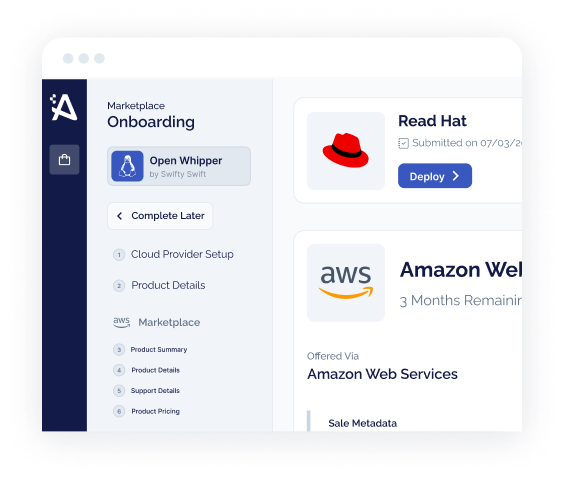
- The standalone Red Hat Marketplace, operated by IBM, is no longer available after April 1, 2025 (IBM, 2025). If you are searching for it to list or buy software, it is gone.
- Certification and discovery moved to the Red Hat Ecosystem Catalog (catalog.redhat.com). Transacting happens through the hyperscaler marketplaces — AWS, Azure, and Google Cloud — plus Red Hat Cloud Access for subscription portability.
- The commercial upside is committed-spend drawdown: a Red Hat purchase through a cloud marketplace draws down an AWS Private Pricing Agreement (PPA), Azure Consumption Commitment (MACC), or Google Cloud committed use discount (CUD) (Red Hat, 2026).
- For an ISV whose product is certified on RHEL or OpenShift, the 2026 play is: certify in the Ecosystem Catalog, then list on the cloud marketplace(s) where your buyers already hold committed spend.
If you went looking for the Red Hat Marketplace this year, you did not find a storefront — you found a deprecation notice. The marketplace that IBM operated for certified Red Hat software has been retired, and that quietly changed the answer to a question a lot of ISVs are still asking: if my product is certified on Red Hat Enterprise Linux or OpenShift, where do I actually sell it now? The short version is that Red Hat split what used to be one destination into two, and confusing them costs you months.
What actually happened to the Red Hat Marketplace
Red Hat Marketplace launched in 2020 as a joint venture with IBM — a single storefront where buyers could find, try, buy, and deploy certified OpenShift Operators. That storefront is being wound down. Per IBM's own notice, the Red Hat Marketplace, operated by IBM, will no longer be available after April 1, 2025 (IBM Support, 2025). Red Hat's customer portal frames it the same way: the Marketplace is deprecated, and customers using partner software through it are advised to migrate to an operator in the Red Hat Ecosystem Catalog (Red Hat Customer Portal, 2025).
The practical effect is that a URL a lot of vendor pages and internal runbooks still point at now leads nowhere useful. If your go-to-market plan from a couple of years ago said "list on Red Hat Marketplace," that line item no longer has a home. But nothing about being certified on Red Hat changed — only where certification is shown and where the money changes hands.
People collapse "Red Hat Marketplace" and "Red Hat Ecosystem Catalog" into one thing. They are not. The retired marketplace was a transaction storefront. The Ecosystem Catalog is a certification and discovery catalog — it proves your product works on Red Hat, but it is not where a buyer pays for it. Buying now happens on the cloud marketplaces.
Where certified software lives now: the Ecosystem Catalog
The discovery layer for Red Hat's ecosystem is catalog.redhat.com. Red Hat describes it as the official source for discovering both Red Hat and certified third-party products — the one place a customer explores the ecosystem instead of hopping between sites (Red Hat, 2024). When Red Hat relaunched it, the catalog spanned more than 12,750 certified products, 7,180 certified containers, and 200 partner pages (Red Hat Partner Connect, 2023). For an ISV, being in that catalog is the trust signal: it tells an enterprise buyer that your software is certified to run on the Red Hat platform they have standardized on.
Certification itself runs through Red Hat's partner programs, and the path depends on what you ship:
Container / Operator certification
Software that deploys to OpenShift certifies as a container or Operator bundle through the Red Hat Connect dashboard, then appears in the catalog for OpenShift customers.
RHEL-certified applications
Applications validated on Red Hat Enterprise Linux certify through the RHCert dashboard — the "certified on RHEL" badge enterprise procurement teams look for.
Ansible content
Automation content is certified and published so it is discoverable to Ansible Automation Platform customers alongside the rest of the ecosystem.
Partner finder & solutions
The relaunched catalog added a partner finder and global search so buyers can match to certified partners by need, not just browse products (Red Hat Partner Connect, 2023).
Getting into the Ecosystem Catalog earns you the badge and the discovery surface. It does not, on its own, give a buyer a way to purchase using their cloud budget. That is a separate motion — and it is where the real commercial leverage sits.
Where the buying happens now: the hyperscaler marketplaces
Red Hat has consolidated transaction onto the three cloud marketplaces its buyers already use. Its partner page is explicit that purchasing Red Hat solutions through a preferred cloud marketplace lets customers deploy using established purchasing agreements and maximize existing cloud investments (Red Hat, 2026). In practice that means Red Hat — and Red Hat-certified ISVs — meet buyers inside AWS, Azure, and Google Cloud marketplaces rather than in a standalone Red Hat storefront.
Red Hat frames the buying options as three models, which map cleanly onto how the hyperscaler marketplaces already work:
| Buying model | What it is | Best for |
|---|---|---|
| Annual subscription | Commit upfront for predictable, long-term planning | Steady-state migrations and known, sustained workloads |
| Pay-as-you-go | Hourly, consumption-based billing with no upfront commit | Burst workloads, short-term experiments, forecasting real usage |
| Private Offer | Custom commercial terms and volume discounts inside the marketplace | Larger deployments that need negotiated pricing and legal terms |
Source: Red Hat on Cloud Marketplaces (Red Hat, 2026).
Two data points show how far this has gone beyond the old model. Red Hat now ships cloud-optimized Red Hat Enterprise Linux images jointly engineered for AWS, Google Cloud, and Azure with the launch of RHEL 10, purchasable pay-as-you-go from the buyer's marketplace of choice (Red Hat, 2025). And by October 2025, Red Hat had made a self-serve RHEL trial available directly on the AWS Marketplace (Red Hat, 2025). For subscription portability there is also Red Hat Cloud Access, which lets customers run eligible existing subscriptions on certified public clouds — the bring-your-own-subscription path alongside marketplace purchasing (Red Hat, 2026).
The commercial reason this matters: committed-spend drawdown
The move to the hyperscaler marketplaces is not just plumbing. It unlocks the single biggest lever in cloud go-to-market. Red Hat states that marketplace purchases can draw down existing AWS Private Pricing Agreement (PPA), Microsoft Azure Consumption Commitment (MACC), and Google Cloud committed use discount (CUD) commitments (Red Hat, 2026). Enterprises pre-commit budget to their cloud providers; software bought through the marketplace burns that budget down instead of requiring net-new spend approval.
An enterprise buyer will move faster on software that spends down a cloud commitment they have already made than on software that asks finance for fresh budget. That is the whole reason marketplace procurement compresses deal cycles.
This is exactly the mechanic that drives marketplace strategy for native AWS, Azure, and GCP listings — and it now applies to Red Hat-certified software too. If your product is certified on OpenShift and your buyer holds an Azure MACC, routing that purchase through the Azure marketplace turns a budget-approval fight into a drawdown. The same logic runs through private offers, where negotiated deals combine the centralized billing of the marketplace with the custom terms of an enterprise contract. If you want to size what a commitment is actually worth to a deal, our committed spend calculator models the drawdown math.
A product can be certified in the Ecosystem Catalog and still have no way for a buyer to purchase it against their cloud commitment. Certification and transactability are separate pieces of work. Skipping the second one is the most common reason a Red Hat-certified ISV has a badge but no marketplace pipeline.
The 2026 playbook for an ISV building on Red Hat
Put the two systems together and the sequence is straightforward, even if the execution is not.
Pick the certification path that matches how you ship — OpenShift Operator, RHEL-certified application, or Ansible content — and get published at catalog.redhat.com. This is your trust signal to Red Hat's installed base.
List on the hyperscaler marketplace where your target accounts already have PPA, MACC, or CUD budget. The right first marketplace is the one whose committed spend your buyers need to burn — not the biggest logo.
Stand up public pay-as-you-go or subscription pricing, then use private offers for larger deals so buyers get negotiated terms while the purchase still draws down their commitment.
Each marketplace meters usage, invoices, and disburses differently. Reconciling what you are actually paid — across AWS, Azure, and GCP — is the ongoing operations tax of selling in more than one.
To make the split concrete, here is an illustrative composite — a hypothetical vendor, not a real Automatum customer:
Consider a 30-person data-security ISV whose product ships as a certified OpenShift Operator. Their instinct is to "list on Red Hat Marketplace" — which no longer exists. The correct move: keep the Operator certification current in the Ecosystem Catalog for discovery, then list the product on the Azure marketplace because their pipeline is full of accounts holding Microsoft Azure Consumption Commitments. A six-figure deal that would have fought for net-new budget instead draws down the customer's MACC, and closes on marketplace paper.
None of the four steps is unique to Red Hat — they are the same motions any ISV runs to sell through the cloud marketplaces. What is Red Hat-specific is only the front door: certification through the Ecosystem Catalog instead of a standalone storefront. Once a buyer wants to pay, they are on AWS, Azure, or GCP like everyone else, and the partner-program mechanics that reward marketplace transactions apply the same way.
Red Hat software now sells where every other ISV's does: AWS, Azure, and GCP.
Automatum runs the marketplace layer across those three clouds — listings, private offers, metering, and disbursement reconciliation — so the transaction path for your certified product is one system instead of three portals. See how it fits on the platform overview.
See Automatum in Action →Frequently Asked Questions
Common questions about the Red Hat Marketplace change, the Ecosystem Catalog, and selling Red Hat-certified software.
Is the Red Hat Marketplace still available?
No. The standalone Red Hat Marketplace, operated by IBM, is no longer available after April 1, 2025 (IBM, 2025). Red Hat's customer portal describes it as deprecated and advises customers to migrate to an operator in the Red Hat Ecosystem Catalog. Certified software is still fully supported — only the standalone storefront is gone.
Where do I list and sell Red Hat-certified software now?
Two places, for two different jobs. Certify and get discovered in the Red Hat Ecosystem Catalog at catalog.redhat.com. Transact through the hyperscaler marketplaces — AWS, Azure, and Google Cloud — where buyers can purchase using existing cloud agreements, plus Red Hat Cloud Access for bringing existing subscriptions to a certified cloud (Red Hat, 2026).
What is the difference between the Red Hat Ecosystem Catalog and a cloud marketplace?
The Ecosystem Catalog is certification and discovery — it proves your product is certified on RHEL or OpenShift and helps buyers find it. A cloud marketplace (AWS, Azure, GCP) is procurement and billing — it handles the purchase, invoicing, and lets the buyer draw down committed cloud spend. You generally need both: the catalog for trust, the marketplace for the transaction.
Can buyers use committed cloud spend to buy Red Hat software?
Yes. Red Hat states that purchases made through a cloud marketplace can draw down existing AWS Private Pricing Agreement (PPA), Microsoft Azure Consumption Commitment (MACC), or Google Cloud committed use discount (CUD) commitments (Red Hat, 2026). That drawdown is the main reason enterprise buyers prefer marketplace procurement — it turns net-new spend into budget they have already committed.
Keep mapping your marketplace strategy
Guides on cloud marketplace mechanics, private offers, and committed spend.